

Does Hair Porosity Affect How Well Hair Holds Curls? Here’s What Changes | Cache' Salon Hanford


Does Hair Porosity Affect How Well Hair Holds Curls? Here’s What Changes
You curl your hair.
It looks great.
Then the shape disappears.
Or maybe your natural curls look defined one day...
and loose, frizzy, or unpredictable the next.
If you've spent any time reading about hair online, you've probably heard:
“It's your porosity.”
Sometimes porosity matters.
But it is rarely the whole answer.
Hair porosity can influence how quickly strands interact with water, conditioning products, humidity, and styling products.
Those things can absolutely affect curl behavior.
But porosity alone does not determine whether your hair can hold a curl.
Quick Answer: Does Hair Porosity Affect How Well Hair Holds Curls?
Yes, hair porosity can affect curl retention, but it is only one part of the picture.
More porous hair may absorb moisture and react to humidity more readily, which can make curl definition or heat-styled shapes change faster. Lower-porosity hair may resist moisture and some products, but product buildup or excess weight can also reduce curl hold.
Curl retention also depends on strand thickness, hair condition, natural texture, length, product weight, humidity, heat technique, and how the curl is allowed to set.
So instead of asking whether high or low porosity holds curls better, ask how your particular hair responds to moisture, products, and styling.
First: Porosity and Curl Pattern Are Not the Same Thing
This is one of the most important distinctions.
Curl pattern describes the shape your hair naturally grows in.
Porosity describes how readily the hair interacts with and moves moisture.
You can have:
straight high-porosity hair
straight low-porosity hair
curly high-porosity hair
curly low-porosity hair
wavy hair anywhere in between
Porosity does not decide whether hair is curly.
And having curly hair does not automatically mean your hair is highly porous.
The two traits can interact...
but they are not interchangeable.
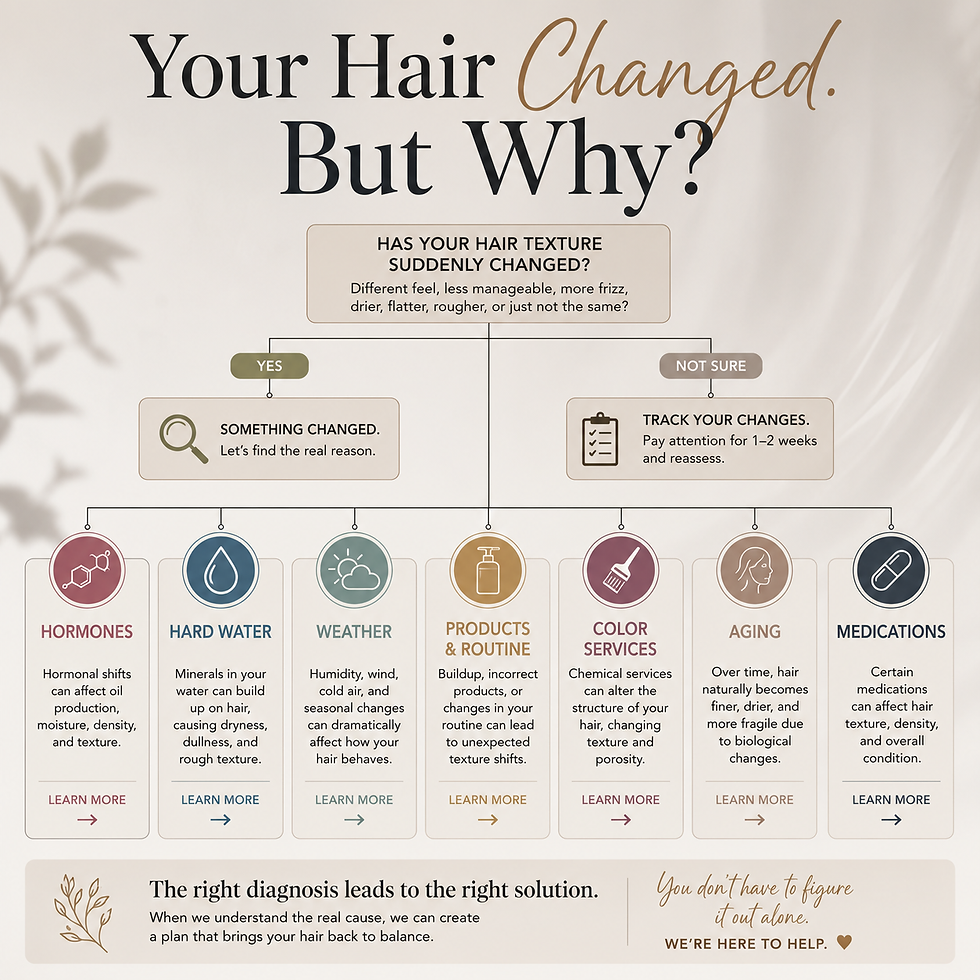
If your hair's overall texture or behavior has changed over time, Why Your Hair Suddenly Changed Texture explains the broader reasons hair can begin responding differently to styling, products, and the environment.
High Porosity vs. Low Porosity and Curl Hold
There isn't one universal winner.
Higher-Porosity Hair | Lower-Porosity Hair |
Moisture may move in more easily | Moisture may enter more slowly |
May react strongly to humidity | May resist some products |
Can become frizzy or swell | Can become coated or weighed down |
May lose moisture quickly | Products may sit on the surface |
Damage may contribute to porosity | Can be completely healthy |
Curl behavior may change quickly | Heavy buildup may flatten curl |
That is why the statement:
“High-porosity hair doesn't hold curls.”
is too simple.
And so is:
“Low-porosity hair holds curls better.”
Both can struggle.
Just for different reasons.
1. Higher-Porosity Hair May React More Quickly to Moisture
More porous hair tends to allow easier movement of moisture through the outer layers of the strand.
That can affect styling.
Imagine you create a beautiful heat-styled curl indoors.
Then you walk into humid air.
If the hair interacts readily with that environmental moisture, its temporary shape may begin changing.
The curl might:
loosen
frizz
expand
stretch
become less defined
That does not mean porous hair is incapable of holding a curl.
It means its environment may influence the shape more noticeably.
If weather seems to be the specific trigger, why your curls fall out in humidity explains why some curls stretch while others frizz or puff up.
2. Lower-Porosity Hair Can Struggle With Curl Hold Too
This is where the internet often oversimplifies things.
Lower porosity doesn't automatically mean:
perfect curl retention.
Products may have more difficulty spreading or absorbing the way you expect.
If you continually add:
leave-in
cream
oil
heat protectant
styling product
the hair may eventually feel coated or weighed down.
And heavy hair doesn't always curl well.
You might notice:
curls start nicely but relax quickly
roots become flat
hair feels coated
products seem to sit on the surface
stronger styling products make the problem worse
In that situation, porosity matters...
but product accumulation and weight may be what actually causes the curl to collapse.
3. High Porosity Doesn't Automatically Mean Damage
This distinction becomes especially important here.
Some people naturally have more porous hair.
Other people develop increased porosity through accumulated:
heat
bleaching
coloring
UV exposure
friction
everyday weathering
So two people can both have high-porosity behavior...
while having very different hair histories.
If you've been assuming high porosity automatically means your hair is damaged, Does High-Porosity Hair Mean Damage? Not Always. Here's How to Tell explains why natural porosity and damage-related porosity shouldn't be treated as the same thing.
4. Damage Can Affect Curl Retention Beyond Porosity
This is another reason we wouldn't diagnose poor curl hold from porosity alone.
Damage can change:
strength
elasticity
surface smoothness
flexibility
breakage risk
Those changes may affect how the strand responds to styling.
So if hair has become heavily lightened or repeatedly exposed to high heat, the question isn't simply:
“Is this high porosity?”
It's:
“What condition is the strand actually in?”
Two high-porosity strands may behave very differently if one is healthy and naturally porous...
while the other is brittle and structurally compromised.
5. Natural Curls and Heat-Styled Curls Need to Be Separated
When someone asks whether porosity affects “holding curls,” we first need to know what kind of curl we're discussing.
Natural Curls
Porosity can affect:
how products distribute
how quickly hair becomes saturated
how the curl responds to humidity
frizz
softness
definition
how long moisture remains in the hair
The goal is primarily to support the curl pattern that already exists.
Heat-Styled Curls
Porosity may influence how the hair interacts with:
styling products
moisture
humidity
conditioning
But curl retention also depends heavily on:
curling temperature
section size
hair thickness
hair length
cooling
product weight
natural texture
The goal is to temporarily create a shape the hair may not naturally have.
Those are different styling problems.
Porosity Might Be the Clue, Not the Diagnosis
This is the way I'd think about it.
If your curls don't hold, ask:
Do they fall only when it's humid?
Porosity and moisture response deserve more attention.
Do they fall immediately even indoors?
Look more closely at:
styling technique
product weight
strand thickness
hair condition
Does your hair feel coated before you curl it?
Buildup may matter more than porosity itself.
Does your hair feel extremely soft and limp?
Moisture balance or product weight may be contributing.
Does your hair feel rough, brittle, or weak?
Look at damage and structural condition.
Has curl retention changed recently?
Something may have changed with:
length
product routine
chemical history
heat use
hair condition
environment
If curl hold is failing throughout your hair and you're not sure what changed, why your hair won't hold curls anymore walks through the broader diagnostic possibilities.
If porosity is only one of several things changing about your hair, our Hair Changes Resource Center brings together guides on texture changes, curl behavior, humidity, product response, and other reasons hair may stop behaving the way it used to.
🌿 Free Hair Reset Guide
Stop Guessing. Start Understanding Your Hair.
Poor Curl Hold Doesn't Automatically Mean You Have the “Wrong”
Porosity
Porosity is useful information.
But curl retention can also be affected by moisture balance, buildup, heat, damage, strand thickness, hair length, products, and the environment.
Those factors often overlap.
The Free Hair Reset Guide walks you through the five biggest factors affecting your hair so you can understand what else may be contributing before rebuilding your routine around a porosity label.
6. Humidity Can Make Porosity Differences Much More Obvious
You may not notice much difference indoors.
Then the weather changes.
Suddenly your hair behaves completely differently.
More porous hair may respond strongly to environmental moisture.
That can make:
natural curls expand
frizz increase
heat-styled curls loosen
sections behave unevenly
That doesn't mean humid weather permanently damaged the hair.
It's revealing how the strand interacts with moisture.
This is why two people can walk outside in the same weather...
and have completely different results.
7. Product Weight Can Matter More Than the Porosity Label
Suppose you think your hair is high porosity.
So you start using:
richer conditioner
heavier masks
leave-in
curl cream
oil
Your hair becomes incredibly soft.
But your curls stop holding.
Was the problem high porosity?
Maybe not.
The routine built around that label may simply be too heavy for your hair.
The same can happen with lower-porosity hair when products repeatedly accumulate.
This is why I would not choose an entire routine based only on an online porosity test.
Watch how your hair actually responds.
Does the Float Test Tell You Whether Your Hair Will Hold Curls?
Not reliably.
You've probably seen the test:
Put a strand of hair in water.
If it floats, low porosity.
If it sinks, high porosity.
The problem is that what happens to a loose strand in a glass can be influenced by things besides porosity, including surface oils, product residue, trapped air, and how the strand was handled.
That makes it a poor reason to completely rebuild your routine.
A more useful approach is observing your hair over time.
Does it:
take a long time to get fully wet?
dry unusually fast or slowly?
become coated easily?
react dramatically to humidity?
lose softness quickly?
absorb products easily?
respond differently after bleaching?
Those patterns give us much more useful context.
Does High-Porosity Hair Hold Heat-Styled Curls Better or Worse?
It can do either.
Some more porous hair has enough surface texture to take a curl readily.
But that same hair may be more reactive to humidity or moisture afterward.
So you could have hair that:
curls easily
but
doesn't retain the curl well in humid conditions.
Other porous hair may also be damaged enough that elasticity and strength are compromised.
That creates a different problem entirely.
This is why:
“high porosity = bad curl hold”
is not a useful rule.
What We'd Recommend in the Salon
When someone says:
"I think my porosity is why my curls won't hold."
we wouldn't start by asking whether they passed a float test.
We'd look at:
natural texture
strand thickness
density
chemical history
heat history
buildup
moisture balance
how quickly the hair wets and dries
whether the curl is natural or heat-styled
what happens to the curl after styling
Then porosity becomes one piece of the diagnosis.
Not the entire diagnosis.
If Your Hair Is Naturally Wavy or Curly
Keune Confident Curl is the most natural Care fit when the goal is supporting natural curl definition and bounce.
Keune positions Confident Curl specifically for curly hair to hydrate and define curls. Its current formulation uses Curlmax Technology and Amaranth Extract, with claims for enhanced curl definition and bounce, long-lasting frizz control, reduced breakage, and 24-hour protection against high humidity.
If You're Creating Curls With a Curling Iron
I would not automatically recommend Confident Curl.
A heat-styled curl has a different set of variables.
If naturally straight hair is struggling to hold a curl, porosity may matter...
but so can temperature, section size, product weight, cooling time, hair length, and condition.
What to Do Next
If you think porosity is affecting your curl hold, do not rebuild your entire routine around one label.
Start with the pattern.
Ask what happens:
before styling
immediately after styling
a few hours later
in humidity
after conditioning
after clarifying
That gives you much better information than simply deciding:
“I have high porosity, so that must be the problem.”
At-Home Support
1. Watch How Your Hair Behaves in Humidity
This is one of the most useful clues.
If your curls look good indoors but change quickly outside, porosity may be part of the reason.
Pay attention to whether the hair:
frizzes
expands
stretches
loses definition
reverts toward its natural texture
That tells you more than the porosity label by itself.
2. Pay Attention to Product Buildup
If your hair is lower porosity or simply prone to buildup, too much product can make curl retention worse.
Watch for:
coating
heaviness
dullness
flat roots
products sitting on the surface
curls that collapse despite stronger styling products
If the hair feels heavy before you even start styling, the problem may be product load rather than lack of curl support.
3. Do Not Over-Condition Just Because You Think Your Hair Is High Porosity
This is a common mistake.
You hear “high porosity.”
So you add:
richer conditioner
masks
leave-ins
creams
oils
Then your curls become:
soft
limp
heavy
difficult to hold
At that point, the routine may be creating the problem.
Use enough conditioning to support the hair.
But do not assume more is always better.
4. Compare Natural Curl Hold With Heat-Styled Curl Hold
If your natural waves or curls hold well but curling-iron curls do not, porosity may not be the main issue.
Look more closely at:
heat technique
section size
temperature
cooling time
product weight
If both natural and heat-styled curls behave unpredictably, porosity and moisture response become more interesting.
5. Let Heat-Styled Curls Cool Fully
If you are using a curling iron, let the curl cool before brushing or separating it.
This matters regardless of porosity.
If the curl is disturbed too early, it may drop before the hair has fully set.
That can make it look like a porosity problem when the real issue is technique.
6. Change One Variable at a Time
Do not simultaneously:
switch shampoo
add a mask
change styling cream
increase heat
start clarifying more often
You will not know what helped.
Instead, change one thing.
Then watch the result.
That makes the pattern much easier to understand.
7. Do Not Chase the Float Test
The float test can make people overconfident.
A strand sinks.
Suddenly the entire routine changes.
A strand floats.
Now every product gets replaced.
That is usually not a good way to make decisions.
Your real-life hair behavior is more useful.
Watch:
wetting speed
drying speed
product buildup
humidity response
softness
frizz
curl retention
chemical history
Those clues tell a more complete story.
A Simple Porosity and Curl-Hold Troubleshooting Order
If you are trying to figure this out at home, use this order.
Step 1
Identify the curl type.
Natural curl?
Or heat-styled curl?
Step 2
Notice when the curl fails.
Immediately?
A few hours later?
Only in humidity?
Step 3
Check product weight.
Does the hair feel coated or heavy?
Step 4
Check moisture balance.
Does the hair feel extremely soft and limp?
Step 5
Check hair condition.
Does the hair feel rough, weak, brittle, or damaged?
Step 6
Look at porosity as one clue among the others.
That order keeps the diagnosis grounded.
What Not to Do
Don't Assume High Porosity Means Damage
Some hair is naturally more porous.
The more important question is whether the hair also shows signs of structural weakness.
Don't Assume Low Porosity Means Healthy
Lower-porosity hair can still have buildup, heat stress, or other issues.
Don't Keep Turning Up the Heat
If curls are not holding, more heat is not always the answer.
That can increase damage without fixing the real cause.
Don't Keep Adding More Product
If the hair is already coated or heavy, more product can make curl retention worse.
Don't Treat a Porosity Label Like a Diagnosis
Porosity describes behavior.
It does not explain everything happening in the hair.
Professional Guidance
A professional consultation may make sense if:
your curl retention changed suddenly
your hair reacts very differently to humidity than it used to
highlighted sections behave differently from unprocessed sections
the hair feels both rough and weak
the hair feels coated despite regular washing
curls collapse regardless of technique
you are unsure whether the issue is porosity, buildup, or damage
At Cache', we'd look at:
natural texture
strand thickness
density
elasticity
porosity
chemical history
heat history
buildup
moisture balance
how the hair behaves in different environments
The goal is to figure out whether porosity is actually driving the problem...
or simply appearing alongside something else.
🌿 Free Hair Reset Guide
Stop Guessing. Start Understanding Your Hair.
Porosity Is Only One Piece of the Puzzle
Curl hold can change because of porosity, moisture balance, product buildup, damage, heat, hair length, humidity, or natural texture.
Those factors often overlap.
The Free Hair Reset Guide walks you through the five biggest factors affecting your hair so you can understand what may actually be changing before rebuilding your routine around a single porosity label.
Professional Insight
When someone says:
"I think my porosity is why my curls won't hold."
we usually ask:
What happens in humidity?
Does the hair feel coated?
Is it naturally curly?
Is it heat-styled?
Has it been heavily lightened?
Does it feel soft and limp?
Does it feel brittle?
That tells us whether porosity is actually the main issue.
Porosity can absolutely matter.
But it usually makes the most sense when we look at it alongside the rest of the hair.
Professional Service Options
Depending on what the hair is showing, useful options may include:
Hair Health Consultation
Porosity Evaluation
Moisture Balance Review
Product Buildup Evaluation
Clarifying Service
Conditioning or Bond-Support Treatment
Curl Pattern Evaluation
Heat-Styling Technique Review
Customized Home Care Recommendations
Not every curl-retention problem needs a treatment.
Sometimes the best next step is simply understanding what variable is actually changing the result.
Stop Asking, “What Porosity Holds Curls Best?”
A better question is:
“How does my hair interact with moisture, products, and styling?”
That gives you something useful.
High porosity can hold curls.
Low porosity can hold curls.
Either can also struggle.
The difference is usually in the full pattern.
Porosity matters.
But it is not the whole story.
Frequently Asked Questions
Does high-porosity hair hold curls better?
Not necessarily. Higher porosity may create more surface texture, but it can also make the hair more reactive to humidity and moisture.
Does low-porosity hair hold curls better?
Not automatically. Lower-porosity hair can still struggle if product buildup or weight causes the curl to collapse.
Can porosity affect heat-styled curls?
Yes. Porosity can influence how the hair interacts with moisture and styling products, which may affect how long a temporary curl lasts.
Can damaged hair lose curls faster?
It can. Damage may affect elasticity, flexibility, and how the hair responds to styling.
Why do my curls fall only in humidity?
Humidity changes the hair's interaction with moisture. More porous hair may respond more dramatically to those changes.
Can over-moisturized hair stop holding curls?
Yes. Hair that becomes overly soft or weighed down may struggle to maintain shape.
Does product buildup affect curl hold?
Yes. Buildup can make the hair heavy, coated, and less responsive to styling.
Is the float test accurate for porosity?
It is not a reliable standalone diagnostic tool. Product residue, oils, and other factors can influence what happens to a strand in water.
Can hair porosity change after bleaching?
Yes. Chemical processing can increase porosity and change how the hair responds to moisture and styling.
When should I see a stylist?
If curl retention has changed significantly, your hair feels weak or unusually porous, or you cannot tell whether buildup, damage, or moisture balance is causing the issue, a stylist can help narrow it down.
Want help choosing the right pro products for your hair? Explore our Keune Experience.
Written by Tammy Brown
Owner of Cache' Salon in Hanford, CA
18-year cosmetologist specializing in color, transformations, and education.


Comments