

Why Your Hair Suddenly Changed Texture (The 6 Most Common Reasons Most People Miss) | Cache' Salon Hanford

Updated: Sep 22
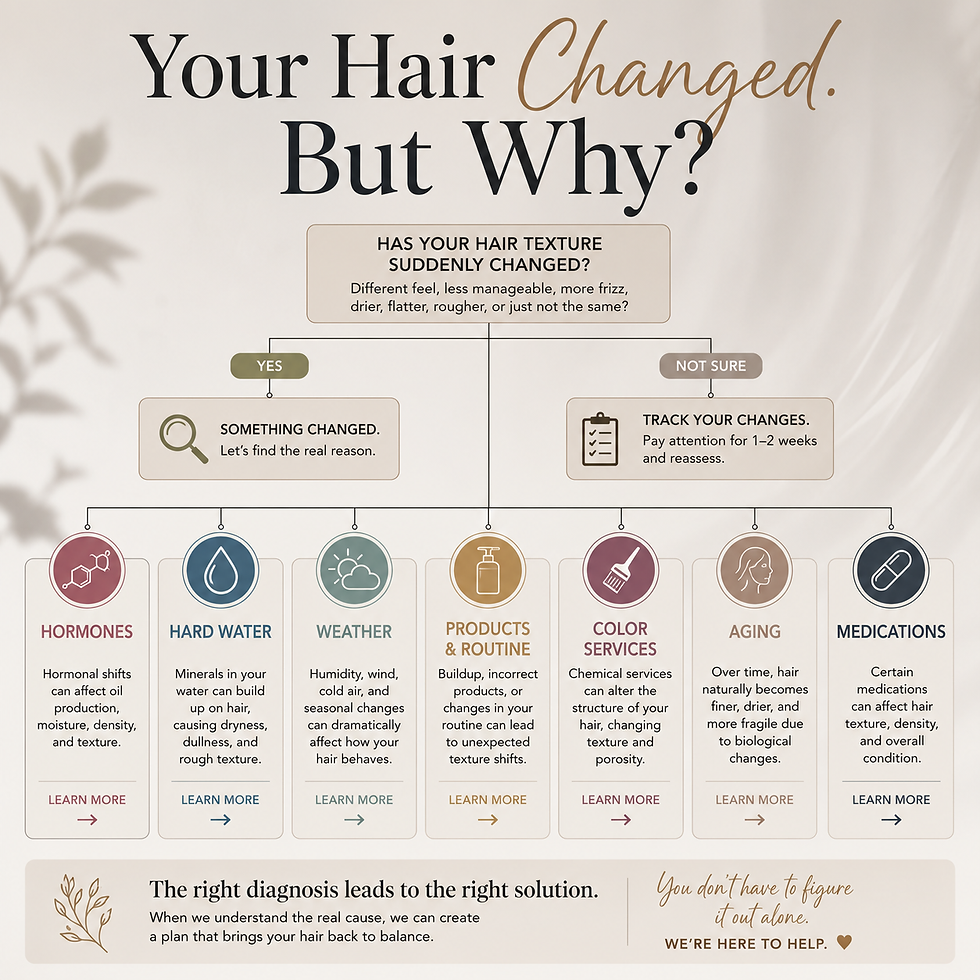
Why Your Hair Suddenly Changed Texture (The 6 Most Common Reasons Most People Miss)
One of the most frustrating hair problems isn't damage.
It's confusion.
Your hair felt normal for years.
Then seemingly overnight it became:
frizzier
rougher
drier
flatter
harder to style
more tangled
less predictable
Most people assume they need new products.
Many don't.
The truth is that hair texture changes almost always have an underlying cause.
The challenge is figuring out which one.
That's exactly why we created the Hair Reset System. Instead of treating every texture change the same, it helps you identify what changed first so you can choose the right solution.
Puffiness is often one of the first signs that your hair's texture or environmental response patterns have changed. Learn more in Why Your Hair Feels Puffy (Even When It Isn't Frizzy).
Quick Answer
If your hair texture suddenly changed, the most common causes are hormonal changes, hard water, climate shifts, product buildup, chemical services, aging, or medications. The key is identifying what changed first because different causes create very different hair behaviors and require different solutions.
Start Here: Match the Product to What Changed
If your hair suddenly feels different, don’t replace your entire routine at once. Start with the symptom that changed most.
If your hair feels dry, rough, or less healthy: We often recommend Keune Care Vital Nutrition Shampoo & Conditioner to support moisture retention and strengthen compromised hair.
If your hair feels coated, dull, or heavy: The problem may be buildup rather than dryness. Keune Care Perfect Clarity Shampoo helps remove residue so the hair can behave more normally again.
If your hair is suddenly frizzier or harder to smooth: Keune Care Velvet Smooth 2-Phase Spray is our go-to leave-in option for smoother, more manageable hair.
Not sure which description fits? Keep reading. The causes below will help you narrow down what actually changed before you buy anything.
Before You Buy New Products
Most people immediately start replacing shampoos, conditioners, masks, and styling products.
Unfortunately, this often creates more confusion.
Hair texture changes are usually symptoms.
The real goal is finding the root cause.
Let's walk through the most common ones.
Cause 1 : Hormonal Changes
Hormones affect far more than hair growth.
They also influence:
oil production
moisture retention
scalp condition
hair diameter
texture perception
Many people notice changes during:
pregnancy
postpartum recovery
perimenopause
menopause
major hormonal fluctuations
Hair may suddenly feel:
finer
rougher
drier
flatter
more difficult to style
Sometimes the change shows up first during styling. How porosity affects curl retention explains why hair may begin reacting differently to moisture, products, humidity, and heat-styled curls.
If your texture change seemed to happen without any obvious haircare change, hormones should be on your list of possibilities.
For a deeper look, read Why Your Hair Suddenly Feels Different (The Hidden Hormonal Changes Most People Don't Consider).
Cause 2: Water Changes
This is one of the most overlooked causes we see in the Central Valley.
Your hair may not have changed.
Your water may have.
Hard water minerals can accumulate on the hair shaft and create symptoms that mimic damage.
Hair may suddenly feel:
rough
coated
dry
dull
difficult to manage
The U.S. Geological Survey explains that hard water contains elevated levels of dissolved minerals, particularly calcium and magnesium.
If you've recently moved, changed water systems, installed a water softener, or traveled extensively, water changes may be the real culprit.
Read:
and
Cause 3: Weather and Climate Changes
Hair responds to its environment constantly.
Humidity, temperature, and seasonal shifts can dramatically affect texture.
Common examples include:
Dry Winter Air
Hair may feel:
brittle
static-prone
rough
Humid Conditions
Hair may feel:
frizzy
swollen
difficult to smooth
Seasonal Transitions
Hair may seem completely different from month to month.
Many clients think their products stopped working when the environment actually changed.
If your hair suddenly feels rough or dull, learning the difference between dry hair and dehydrated hair can help you narrow down the cause.
Read:
and
Cause 4: Product or Routine Changes
Sometimes nothing is technically wrong with your hair.
The routine simply stopped matching your current needs.
Common triggers include:
product buildup
seasonal changes
changing hair goals
incorrect product layering
over-conditioning
under-conditioning
You may notice:
reduced volume
heaviness
dryness
inconsistency
Many people say:
"My hair was fine six months ago."
That's often because the routine worked six months ago.
Not necessarily today.
Read:
and
If your hair still looks similar but suddenly behaves differently when styled, why your hair won't hold curls anymore explains how buildup, moisture balance, damage, humidity, and texture changes can affect curl retention.
If the change seems concentrated near the scalp rather than throughout the entire head, curls falling flat at the roots can also be related to hair weight, buildup, styling technique, or the natural pattern near the scalp.
Cause 5: Color Services and Chemical Processing
Hair color doesn't just affect color.
It can affect texture.
Even beautifully healthy-looking hair can feel different after:
highlights
balayage
blonding
gray blending
corrective color
Many clients report:
increased dryness
roughness
tangling
altered elasticity
before they notice visible damage.
If you've colored your hair recently, this should be one of the first areas you investigate.
Read:
and
Cause 6: Aging
This one surprises many people.
Hair changes naturally over time.
As we age, hair can become:
finer
coarser
drier
less elastic
more resistant
more fragile
This isn't necessarily damage.
It's biology.
Hair that behaved one way in your twenties may behave very differently in your forties, fifties, and beyond.
Many people continue using routines designed for a younger version of their hair.
That often creates frustration.
Aging is one of the most overlooked causes of texture changes because the shift usually happens gradually over time. Learn more in Why Your Hair Texture Changes As You Age (And Why Your Old Routine Stops Working).
Cause 7: Medications
Certain medications can affect:
hair texture
scalp oil production
moisture retention
hair growth cycles
Changes sometimes occur gradually enough that people don't connect the dots.
If a texture shift occurred after starting a new medication, discussing it with your healthcare provider may be worthwhile.
Never stop medication without medical guidance.
One commonly overlooked cause of sudden texture changes is medication. Learn more in Why Your Hair Changed After Starting A New Medication (The Connection Most People Miss).
Why These Problems Get Misdiagnosed
This is where most people get stuck.
Different causes create similar symptoms.
For example:
Dryness can be caused by:
hard water
weather
hormones
color services
aging
Frizz can be caused by:
humidity
damage
texture changes
buildup
Roughness can be caused by:
mineral deposits
chemical processing
aging
environmental stress
The symptom isn't always the diagnosis.
Hair changes aren't always perfectly symmetrical. If one side suddenly styles differently from the other, why one side of your hair holds curls better explains what differences in texture, damage, styling technique, and daily habits may reveal.
Another characteristic that can shift as your hair accumulates chemical, heat, and environmental wear is porosity. If products or water suddenly seem to interact differently with your hair, here's why hair porosity can change over time.
🌿 Not Sure What's Actually Changing Your Hair?
Dryness, frizz, roughness, and texture changes can all look similar—but they don't always have the same cause. That's why treating the symptom without understanding the underlying issue often leads to more frustration.
The free Hair Diagnosis Guide walks you through the five biggest factors that influence hair health so you can stop guessing and start building a routine based on what your hair actually needs.
Hair Texture Change Decision Tree
Did You Recently Move?
Start here:
Did The Change Happen After Coloring?
Start here:
Did The Change Coincide With Seasonal Changes?
Start here:
Did Nothing Obvious Change?
Start here:
Is Your Routine Suddenly Failing?
Start here:
What We'd Recommend in the Salon
When someone comes into Cache' Salon because their hair suddenly feels completely different, we rarely start by changing everything.
Instead, we first determine what changed and recommend products that address the underlying cause rather than simply treating the symptoms.
These are some of the products we most commonly recommend depending on what's affecting the hair.
If your hair suddenly feels dry, rough, or less healthy
When texture changes are related to moisture loss or environmental stress, we often recommend Keune Care Vital Nutrition Shampoo & Conditioner.
The updated formulas contain Immortelle Extract and Biomimetic Ceramides to replenish essential lipids, strengthen damaged strands, and improve moisture retention. Keune's testing found hair was 77% more nourished with 84% less breakage as part of the Vital Nutrition routine.
→ Learn More & Shop Vital Nutrition Shampoo
If your hair suddenly feels coated, dull, or heavy
Sometimes the texture hasn't changed at all. Product residue or hard water minerals are simply preventing your hair from behaving normally.
In those cases, we often recommend Keune Care Perfect Clarity Shampoo to remove buildup and prepare the hair to better absorb conditioning treatments. It's designed to deeply cleanse the hair and scalp while removing product buildup and preparing the hair for future salon treatments.
→ Learn More & Shop Perfect Clarity Shampoo
If your hair is becoming frizzier or harder to smooth
When texture changes are caused by humidity, rough cuticles, or increased porosity, we often recommend Keune Care Velvet Smooth 2-Phase Spray.
Its updated formula contains Biomimetic Lipids and Tulip Extract to reduce frizz by up to 70%, provide 48-hour anti-frizz protection, and improve smoothness without weighing the hair down.
→ Learn More & Shop Velvet Smooth 2-Phase Spray
Not sure which routine fits your hair?
Before purchasing new products, download our free Hair Reset Guide to better understand why your hair changed. The right products become much easier to choose once you identify the underlying cause.
Professional Insight
One of the biggest misconceptions in haircare is the belief that texture changes are random.
They aren't.
Hair almost always responds to something.
The challenge is identifying what changed before the symptoms appeared.
The clients who improve their hair the fastest are usually the ones who stop chasing symptoms and start identifying causes.
🌿 Your Hair Didn't Change Overnight for No Reason.
Whether your hair suddenly became rough, flat, frizzy, dry, or difficult to manage, there's usually an underlying reason. Understanding what changed is the first step toward choosing products that actually help.
The free Hair Reset Guide walks you through the biggest factors that influence hair health so you can stop guessing and start making confident hair care decisions.
When To Get Professional Help
If your texture change is severe, persistent, or affecting your confidence, professional evaluation can help shorten the trial-and-error process.
Explore our:
The right diagnosis often saves far more time and money than another round of random product purchases.
FAQ
Why did my hair texture suddenly change?
The most common causes are hormones, hard water, weather changes, routine changes, color services, aging, and medications.
Can hard water change hair texture?
Yes. Mineral buildup can make hair feel rough, dry, coated, or difficult to manage.
Can hormones affect hair texture?
Absolutely. Hormonal changes can alter oil production, moisture retention, and overall hair behavior.
Why does my hair suddenly feel frizzy?
Weather changes, humidity, hard water, damage, and hormonal shifts can all contribute.
Can medications change hair texture?
Some medications can affect moisture levels, oil production, and growth cycles.
Does hair texture naturally change with age?
Yes. Aging can influence thickness, elasticity, moisture retention, and manageability.
Why don't my old products work anymore?
Because your hair may have changed while your routine stayed the same.
Want help choosing the right pro products for your hair? Explore our Keune Experience.
Written by Tammy Brown
Owner of Cache' Salon in Hanford, CA
18-year cosmetologist specializing in color, transformations, and education.


Comments