

Does Hair Drying Time Tell You Your Porosity? What Fast and Slow Drying Really Mean | Cache' Salon Hanford


Does Hair Drying Time Tell You Your Porosity? What Fast and Slow Drying Really Mean
You wash your hair.
You step out of the shower, gently squeeze out the water, and let it air-dry.
An hour later, your ends are almost dry, but your roots are still damp.
Or maybe your hair dries so quickly that you barely have time to apply your styling products.
You've probably heard that fast-drying hair means high porosity and slow-drying hair means low porosity.
But is it really that simple?
Not quite.
Quick Answer: Can You Tell Hair Porosity by How Fast It Dries?
Hair drying time can provide clues about porosity, but it cannot reliably determine your hair's porosity on its own.
High-porosity hair may absorb water readily and release it relatively quickly, especially when the cuticle has been damaged. Low-porosity hair may resist initial wetting and sometimes take longer to dry.
However, drying time also depends on hair density, strand thickness, length, humidity, airflow, product buildup, and how much water remains after washing.
Fast-drying hair is not automatically high porosity, and slow-drying hair is not automatically low porosity.
The better approach is to consider drying time alongside how your hair absorbs water, responds to conditioner, feels when dry, and behaves after chemical or heat treatments.
Why Hair Drying Time Can Be Misleading
Hair porosity describes how readily water and other substances can enter and move through the hair fiber.
The cuticle, the protective outer layer of each strand, plays an important role in this process.
When the cuticle is relatively intact, it helps regulate how water interacts with the hair.
When the cuticle has been altered by chemical processing, heat, or repeated physical wear, hair may become more permeable.
But there's an important distinction.
How easily an individual strand takes up water is not the same thing as how quickly an entire head of hair dries.
Someone with very dense, healthy hair may need several hours to air-dry because thousands of strands are holding water close together.
Someone with fine, low-density hair may dry much faster, even when their cuticles are relatively intact.
That doesn't mean the second person's hair is more damaged.
And it doesn't mean the first person's hair has low porosity.
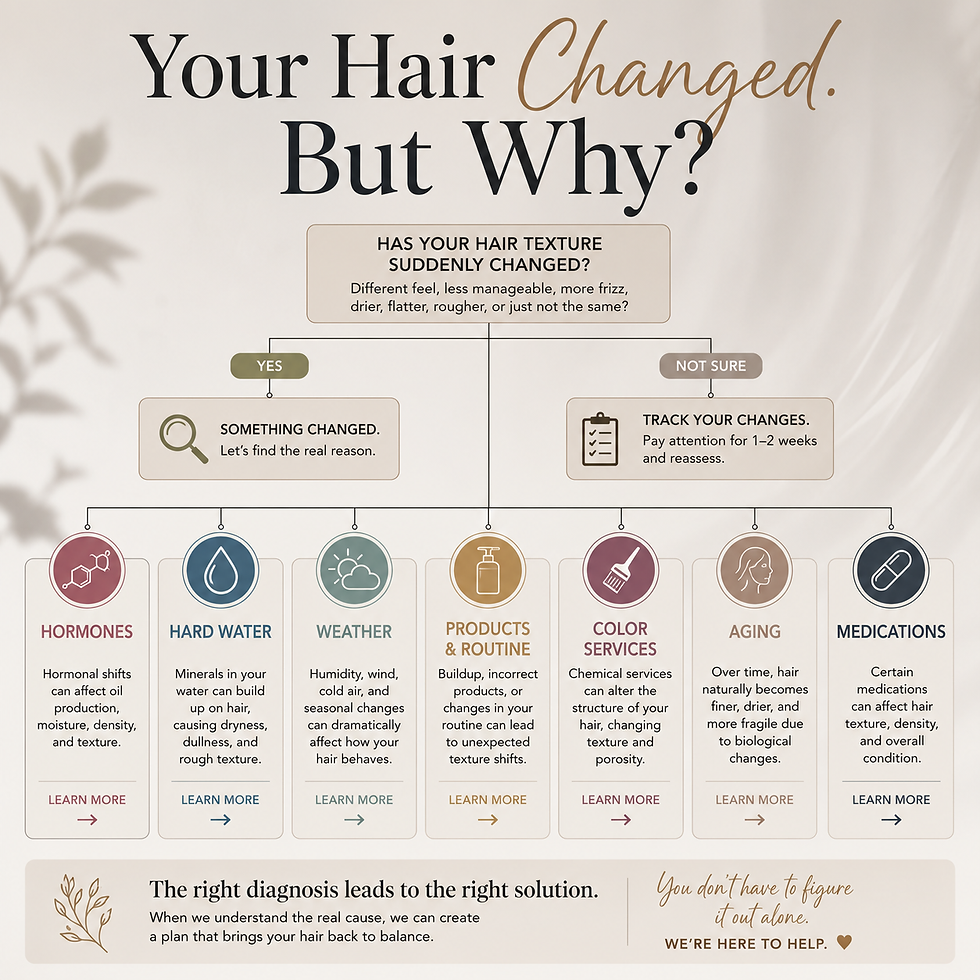
If you've noticed that drying time changed along with your texture, our guide to why your hair suddenly changed texture explains the broader factors that may be involved.
Fast-Drying vs. Slow-Drying Hair: What Each Can Mean
What you notice | Possible explanation | What it does not prove |
Hair dries unusually fast | Fine strands, lower density, damage, or less water retained after washing | High porosity |
Hair takes hours to dry | High density, thick strands, limited airflow, humidity, or product residue | Low porosity |
Ends dry before roots | Older, more weathered ends or better airflow around the lengths | That all your hair has the same porosity |
Hair takes longer to dry after applying products | Creams, gels, oils, or styling methods may slow evaporation | That porosity has decreased |
Drying time changed after bleaching | Chemical processing may have altered the fiber | The exact degree of damage |
The most useful information often comes from how your drying time has changed, rather than whether your hair dries quickly or slowly compared with someone else's.
🌿 Free Hair Reset Guide
Stop Guessing. Start Understanding Your Hair.
Does Your Hair Dry Differently Than It Used To?
When your hair suddenly takes longer to dry, feels rough after air-drying, or seems to lose moisture unusually quickly, it's tempting to assume your porosity has changed. But buildup, damage, environmental conditions, and your routine can create similar symptoms.
Our free Hair Reset Guide helps you understand the five biggest factors affecting your hair so you can begin identifying what has changed before buying another product or completely replacing your routine.
Does Fast-Drying Hair Mean High Porosity?
Sometimes, but not necessarily.
High-porosity hair often has a more permeable cuticle, allowing water to move into the hair fiber more readily.
Depending on the condition of the strand and the surrounding environment, water may also leave the hair more readily.
This is one reason some people with chemically damaged hair notice that their lengths become wet quickly and seem to dry faster than they used to.
However, the relationship isn't universal.
Your hair might dry quickly because it is fine
Fine strands have less overall mass than coarse strands of similar length.
They can dry relatively quickly simply because there is less material and often less water to evaporate.
This can happen even when the hair is healthy.
Your hair might dry quickly because you have lower density
Density describes how many strands grow within an area of your scalp.
Lower-density hair often allows more air to circulate between strands.
That can shorten drying time.
Your hair might dry quickly because of damage
Repeated bleaching, chemical processing, and excessive heat can alter the hair fiber.
If you notice that your ends dry much faster than your roots, feel rough, tangle easily, and break more frequently, structural damage becomes a more meaningful possibility.
But drying time alone still isn't enough to confirm it.
For a closer look at that distinction, read whether high-porosity hair always means damaged hair.
Does Slow-Drying Hair Mean Low Porosity?
Slow drying is commonly associated with low-porosity hair, but the connection is less dependable than many online quizzes suggest.
Low-porosity hair may resist initial wetting because its cuticle presents a relatively effective barrier.
However, once the hair is thoroughly saturated, drying time depends on many additional factors.
Dense hair can trap moisture between strands
Imagine two people with similar hair length and texture.
One has relatively low-density hair.
The other has very dense hair.
Even if their individual strands have similar porosity, the second person's hair may take considerably longer to dry.
There is simply more wet hair packed into the same space.
Thick hair can take longer to dry
Coarse strands have a larger diameter than fine strands.
That changes the amount of hair material and water involved.
It's one reason comparing your drying time to someone with a completely different hair type can be misleading.
Your roots may dry more slowly than your ends
The hair closest to your scalp is surrounded by other strands and often receives less airflow.
The lengths and ends are more exposed.
This difference can be especially noticeable in thick or curly hair.
Slow-drying roots don't automatically mean low porosity.
Can Your Hair Have Different Drying Times in Different Sections?
Absolutely.
Your hair isn't one uniform material.
The strands around your face may be finer than the strands at the back of your head.
Your ends may have experienced years of heat styling, sunlight, coloring, brushing, and friction.
Your roots are newer and haven't experienced that same history.
That means the sections can behave differently when wet.
You might notice that:
Your face-framing pieces dry first.
Your ends become dry while the middle remains damp.
Your crown dries quickly but the underside stays wet.
Previously bleached sections dry differently from untouched hair.
These patterns may reflect differences in strand thickness, exposure, density, damage, or airflow.
Porosity can be part of the explanation, but it isn't necessarily the only one.
In fact, hair porosity can change over time, particularly as individual strands accumulate chemical and physical wear.
What Actually Controls How Fast Hair Dries?
Rather than assigning a porosity label immediately, it helps to understand the factors influencing drying time.
Hair density
More hair packed together generally means less airflow between strands.
Dense hair can remain damp near the scalp long after the ends feel dry.
Strand thickness
Fine and coarse strands have different physical characteristics.
This affects how much water is involved and how quickly the hair may dry.
Hair length
Longer hair has more total surface area and hair mass to dry.
It may also contain older, more weathered sections that behave differently from the roots.
Humidity and airflow
Hair usually dries more slowly when surrounding air is humid because evaporation becomes less efficient.
A dry room with moving air may produce a completely different drying time from a humid bathroom.
Products left in the hair
Conditioners, creams, gels, and styling products can change how water spreads through the hair and how readily it evaporates.
Some products create a coating or hold water within a styled section.
Others may affect how strands separate.
Chemical and heat history
Bleaching, coloring, and excessive heat can alter the cuticle and internal structure of hair.
These changes may affect water absorption and drying behavior.
Research on the weathering of human hair describes how chemical treatments, grooming, and environmental exposure contribute to progressive changes in the hair fiber.
How you remove water after washing
A person who gently squeezes out water and uses a microfiber towel will often begin air-drying with less water remaining than someone who leaves their hair dripping wet.
Even the way you wash and dry your hair can change the result.
What If Your Hair Suddenly Takes Much Longer to Dry?
This is where drying time becomes a more interesting clue.
If your hair has always taken three hours to air-dry, that may simply be normal for your density, length, and routine.
But if your hair used to dry in an hour and now stays damp much longer, something may have changed.
Product buildup may be affecting your routine
Layering leave-ins, creams, oils, dry shampoo, and styling products can change how your hair feels and behaves.
Some buildup may leave hair feeling heavy or coated.
You may also notice that conditioner seems less effective or that your hair feels strange even after washing.
That doesn't necessarily mean your porosity changed.
Your hair may be holding more water because of styling changes
Switching from a lightweight leave-in to a heavier cream can affect drying.
So can changing how much product you apply.
For curly hair, styling wet hair into tightly grouped sections or using a strong-hold gel can also change the drying experience.
Your environment may have changed
Seasonal humidity, moving to a different climate, and changes in indoor airflow can all affect evaporation.
If your hair dries differently only at certain times of year, investigate the environment before assuming structural damage.
Your hair may have become denser or longer
Growing out your hair changes the total amount of hair you need to dry.
A new haircut can have the opposite effect.
Sometimes the explanation is that straightforward.
What If Your Hair Suddenly Dries Much Faster?
A sudden reduction in drying time deserves a different set of questions.
Have you recently bleached or highlighted your hair?
Are the ends becoming rougher?
Does your hair tangle more easily?
Do the lengths feel brittle or break when brushed?
If faster drying appears alongside those changes, it's worth evaluating the condition of the hair fiber.
However, if you've recently cut several inches off your hair, changed your towel routine, or moved somewhere with lower humidity, the explanation may have nothing to do with damage.
The pattern matters more than the stopwatch.
Can You Test Your Hair Porosity by Timing How Long It Takes to Dry?
Not reliably.
A drying-time test is often presented online as though it produces a definitive result.
For example:
Dries quickly = high porosity
Dries at an average speed = medium porosity
Takes hours = low porosity
The problem is that there are no universal drying-time thresholds that reliably classify hair porosity across different hair types and conditions.
A person with dense curls cannot meaningfully compare their drying time to someone with fine, straight hair and assume the difference is caused by porosity.
Even testing your own hair can be inconsistent if you change the weather, products, towel, or drying method.
What about the hair float test?
You may have seen the test where a strand of hair is dropped into a glass of water.
The idea is that sinking indicates high porosity while floating indicates low porosity.
Unfortunately, floating and sinking can be influenced by surface tension, trapped air, product residue, and other factors.
It isn't a reliable standalone way to diagnose porosity.
Professional evaluation considers the hair's history and behavior rather than relying on one household test.
How to Better Understand Your Hair's Porosity
Instead of timing one wash day, look for patterns across several washes.
Ask yourself these questions.
Does your hair wet easily?
Some hair becomes saturated quickly, while other hair takes more time for water to penetrate.
Notice the difference, but don't treat it as proof by itself.
Do your roots and ends behave differently?
If your ends become wet quickly, dry differently, and feel rougher than your roots, accumulated wear may be involved.
Has your hair been chemically processed?
Bleaching and other chemical treatments can increase permeability and change the condition of the cuticle.
Does your hair feel rough or tangle easily?
Those symptoms may suggest surface damage, but buildup and other factors can contribute.
Does conditioner improve your hair temporarily?
Conditioner can improve softness and manageability without permanently reversing structural damage.
Has your routine or environment changed?
A different shampoo, leave-in, climate, water source, or styling method may explain a change in drying behavior.
For a broader perspective on why familiar products can suddenly feel less effective, see why your hair slowly stops responding to products.
What Should You Do If Your Drying Time Has Changed?
At-Home Support
Start by making your routine more consistent.
For two or three wash days, use approximately the same shampoo, conditioner, styling products, and drying method.
Pay attention to whether the weather is unusually humid or dry.
Notice how your roots and ends behave separately.
If you use multiple styling products and your hair feels coated, consider whether buildup may be contributing.
Avoid using very high heat simply because your hair takes a long time to dry. Use an appropriate heat protectant and controlled dryer settings.
And don't assume that you need to completely change your products because of a single drying-time observation.
Professional Guidance
A stylist can evaluate the condition of your hair in ways a simple drying-time test cannot.
During a consultation, we would want to know about your color history, heat habits, products, recent changes, and where the hair behaves differently.
We would also look at the hair's surface condition, elasticity, breakage, and manageability.
If the issue appears related to damage, our Hair Health & Repair Guide explains how to distinguish dryness, breakage, and structural concerns before choosing an approach.
What We'd Recommend in the Salon
At Cache' Salon, we wouldn't recommend a product based only on whether your hair dries quickly or slowly.
We would first want to understand how the hair feels, what treatments it has experienced, and whether buildup or damage may be affecting its behavior.
If your hair feels coated, heavy, and takes longer to dry
Keune Perfect Clarity
If product buildup is contributing to that coated feeling, Keune Perfect Clarity is designed to deeply cleanse the hair and scalp and remove product buildup.
It may be a useful starting point when the concern is residue rather than structural damage.
Clarifying isn't something every head of hair needs frequently, and it won't change your natural porosity.
Learn More & Shop Keune Perfect Clarity
If your hair dries quickly and feels rough, dry, or fragile
Keune Vital Nutrition
When dryness and fragility are the main concerns, Keune Vital Nutrition is a more appropriate direction.
The current Care range is formulated to nourish and hydrate dry hair, using ingredients including biomimetic ceramides.
It can support softness and conditioning, but it cannot make severely damaged hair structurally identical to untouched hair.
Learn More & Shop Keune Vital Nutrition Shampoo & Conditioner
The goal isn't to make your hair dry faster or slower.
It's to help your hair feel and behave better.
🌿 Free Hair Reset Guide
Stop Guessing. Start Understanding Your Hair.
Your Drying Time Is a Clue. Your Entire Hair Routine Tells the Story.
When your hair starts behaving differently, it's easy to focus on one explanation. But fast drying, slow drying, roughness, buildup, and damage can overlap, which is why the wrong solution can leave you frustrated.
Our free Hair Reset Guide walks you through the five biggest factors affecting your hair, helping you recognize patterns, simplify your routine, and make more informed decisions about what your hair actually needs.
Professional Insight: We Look at the Hair, Not the Clock
One of the first things we'd want to know at Cache' Salon is whether your drying time has always been this way.
That's often more useful than the number of minutes it takes.
If you've always had thick, dense hair that stays damp for hours, that may be normal.
If your previously smooth ends suddenly dry quickly, feel brittle, and tangle more easily after repeated lightening, that's a different situation.
We would also want to know whether your hair feels better or worse once it's completely dry.
Does it become soft and manageable?
Or does it feel rough, stiff, fragile, or coated?
Those observations help us distinguish a drying characteristic from a hair-health concern.
The objective isn't to assign everyone a porosity label. It's to understand why their hair behaves the way it does.
When Does It Make Sense to Visit a Salon?
Consider a professional consultation if your drying time changes alongside persistent breakage, unusual roughness, excessive tangling, or noticeable changes after chemical services.
A stylist may be able to identify whether you would benefit from an adjustment to your cleansing routine, a conditioning treatment, a haircut, or a different approach to heat styling.
For clients in Hanford and the surrounding Central Valley, Cache' Salon can help evaluate the hair's condition and discuss realistic next steps.
Not every concern requires a salon treatment.
Sometimes understanding the problem is enough to make a better decision at home.
If your hair has started behaving differently and you're trying to understand why, explore our Hair Changes Resource Center for more guidance on changes in texture, porosity, and how your hair responds to everyday care.
Frequently Asked Questions
Does hair that dries fast always have high porosity?
No. Fine strands, low density, airflow, and the amount of water remaining after washing can all make hair dry quickly. Fast drying alone does not establish high porosity.
Does low-porosity hair take forever to dry?
Not necessarily. Low-porosity hair may resist initial wetting, but drying time also depends on density, thickness, products, and environmental conditions.
Can high-porosity hair take a long time to dry?
Yes. Very dense or thick hair can take a long time to dry even when individual strands are relatively porous.
Why do my ends dry faster than my roots?
Ends receive more airflow and are generally older than the hair near your scalp. They may also have more accumulated wear, especially after chemical processing or repeated heat styling.
Why does my hair take longer to dry after conditioner?
Conditioning and styling products can change how strands retain and release water. The effect depends on the product, how much is applied, and how the hair is styled.
Can bleaching make hair dry faster?
Bleaching can increase hair-fiber permeability and alter how water interacts with the strand. Some people notice changes in drying behavior afterward, but faster drying isn't guaranteed.
Is the hair float test accurate for porosity?
No. It can be affected by surface tension, trapped air, and product residue. It should not be used as a definitive porosity test.
Can product buildup make my hair seem low porosity?
Product residue can change how hair wets, feels, and responds to products. Those effects can resemble characteristics people associate with low porosity, but they don't necessarily indicate a structural change.
Can hair porosity change over time?
Yes. Chemical treatments, heat, and accumulated physical wear can alter hair-fiber permeability. New growth and older ends may therefore behave differently.
Want help choosing the right pro products for your hair? Explore our Keune Experience.
Written by Tammy Brown
Owner of Cache' Salon in Hanford, CA
18-year cosmetologist specializing in color, transformations, and education.


Comments