

Why Do My Curls Fall Out in Humidity? 7 Reasons They Won’t Hold | Cache' Salon Hanford

Updated: 5 days ago

Why Do My Curls Fall Out in Humidity? 7 Reasons They Won’t Hold
Your curls look perfect when you leave the house.
Defined.
Bouncy.
Exactly how you wanted them.
Then you step outside.
The air feels humid...
and suddenly the shape starts changing.
Maybe your curls loosen.
Maybe they puff up.
Maybe they frizz.
Or maybe they seem to disappear completely.
Humidity can absolutely change the way hair holds a curl.
But the reason isn't simply that “humid weather ruins hair.”
The way your hair reacts depends on porosity, hair condition, moisture balance, styling products, natural texture, and how the curl was created in the first place.
Quick Answer: Why Do Curls Fall Out in Humidity?
Curls can fall out in humid weather because hair interacts with moisture in the surrounding air.
When humidity rises, water molecules can move into the hair and affect the temporary bonds that help determine its shape. Hair that is porous, damaged, overly soft, or not well supported by styling products may change shape more dramatically.
That can show up as curls becoming:
looser
frizzier
puffier
flatter
less defined
Humidity doesn't affect everyone the same way. The most useful clue is what your curl turns into once the weather changes. A curl that gets frizzy may point toward a different problem than one that simply stretches and falls flat.
Humidity Doesn't Always Make Curls Curlier
This is a common assumption.
People hear:
“Water makes curly hair curl.”
So they expect humidity to create more curl.
Sometimes it does.
But sometimes humidity causes the curl to:
loosen
stretch
swell
become frizzy
lose definition
collapse
The difference comes down to what the hair was doing before it encountered the humid air.
A naturally curly strand.
A heat-styled curl.
A damaged highlighted strand.
A fine straight strand curled with an iron.
All four can respond differently.
If your curls are struggling to hold even when humidity isn't the issue, why your hair won't hold curls anymore explains the broader causes of disappearing curl retention.
What Humidity Can Do to Your Curl
What Happens | What It May Suggest |
Curl gets frizzy but stays curly | Surface moisture movement, porosity |
Curl stretches and loosens | Weak hold, hair weight, moisture response |
Curl goes almost straight | Heat-styled shape is being disrupted |
Roots collapse | Weight, moisture, density |
Curl becomes puffier | Natural texture reacting to moisture |
Only damaged sections change | Porosity or structural differences |
That is why “humidity ruined my curls” is only the beginning of the diagnosis.
1. Humidity Changes the Hair's Temporary Shape
Hair doesn't stay in one shape because of one permanent structure.
Some of the bonds that influence hair shape are temporary and can change with water.
That's why:
wet hair behaves differently from dry hair
blowouts can revert
heat-styled curls can loosen
straightened hair can become wavy again
Humidity introduces more moisture into the environment.
That can affect the hair without you ever getting it visibly wet.
If your curl was created temporarily with heat, humid air may gradually weaken that
styled shape.
The result?
A curl that looked tight indoors...
starts stretching outside.
2. Porous Hair May React More Dramatically
Porosity describes how readily water moves into and out of the hair.
More porous hair may interact with environmental moisture more quickly.
That doesn't automatically mean the hair is damaged.
But porous hair may show more dramatic changes in:
frizz
expansion
softness
texture
curl definition
when humidity rises.
This is where your upcoming porosity-and-curl article will connect especially well.
For now, if you're trying to understand whether porosity automatically means something is wrong with the hair, does high-porosity hair always mean damage? explains the difference between porous behavior and structural damage.
Humidity problems are often blamed on porosity, but that relationship is more nuanced. How hair porosity affects curl hold explains why porous hair may react more strongly to moisture while lower-porosity hair can struggle for completely different reasons.
3. Damaged Hair May Respond Unevenly
Humidity problems can become especially obvious when different sections of the hair have different histories.
For example:
newer roots
may be relatively healthy.
But:
older highlighted ends
may be more weathered or porous.
You may notice that the roots stay controlled while the ends:
frizz
expand
loosen
lose definition
Or the front pieces may react differently because they have received more:
heat
lightener
brushing
sun exposure
This isn't necessarily the weather treating one section differently.
The weather may simply be revealing differences that were already in the hair.
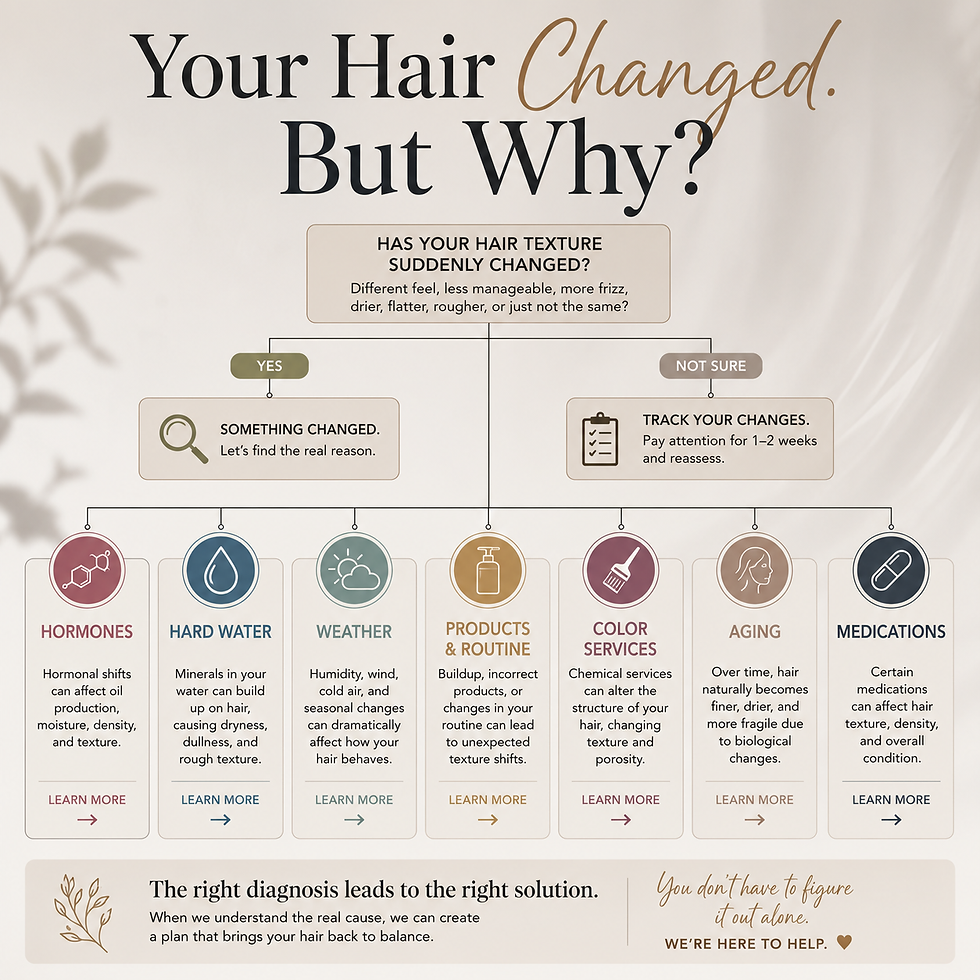
If your overall texture or behavior has been changing more broadly, Why Your Hair Suddenly Changed Texture explains why hair can begin responding differently to products, styling, and the environment over time.
4. Your Hair May Be Too Soft to Hold Up Against Humidity
This one is easy to miss.
A curl needs flexibility.
But it also needs enough structure to maintain shape.
If the hair is extremely:
soft
heavily conditioned
weighed down
over-moisturized
coated in rich products
humidity may make that softness even harder to control.
You might notice:
curls look good initially
they feel very soft
they slowly stretch
definition disappears
the shape gets flatter as the day goes on
This doesn't mean moisture is bad.
It means more moisture isn't automatically better hold.
If your hair feels unusually soft, limp, or unable to maintain shape, can you over-moisturize your hair? explains how excessive conditioning can sometimes work against styling.
5. Fine Hair Can Lose Shape Faster
Fine hair can be especially sensitive to humidity because small changes in weight and moisture can make a big difference.
Fine strands may:
absorb product easily
become weighed down quickly
lose volume at the root
stretch under the weight of the curl
struggle to maintain heat-styled shape
Add humidity...
and a curl that already had limited support may loosen even faster.
This is one reason a heavy anti-frizz routine can backfire on fine hair.
You control the frizz...
but flatten the curl.
The right balance matters more than using the richest product.
🌿 Free Hair Reset Guide
Stop Guessing. Start Understanding Your Hair.
Humidity Is Often Revealing What Your Hair Was Already Struggling With
When curls collapse in humid weather, it's easy to blame the weather alone.
But porosity, product weight, moisture balance, damage, natural texture, and styling technique all affect how dramatically your hair responds.
The Free Hair Reset Guide walks you through the five biggest factors affecting your hair so you can understand why humidity changes your curls before adding more product or increasing your heat.
6. The Product You Use May Not Be Giving Enough Humidity Support
Not every styling product is designed for the same environment.
Something that works perfectly on a dry day may struggle when humidity rises.
That doesn't automatically mean the product is “bad.”
It may simply not provide enough:
curl support
frizz control
moisture resistance
definition
for the conditions you're in.
And piling on more product doesn't always fix the problem.
Too much can create weight.
So the goal is not:
more product
It's:
the right product in the right amount for your hair.
7. How You Create the Curl Matters
Humidity can affect both:
natural curls
and
heat-styled curls
but not for exactly the same reason.
Naturally Curly Hair
Humidity may alter:
definition
frizz
expansion
shrinkage
curl grouping
The curl itself is natural.
You're trying to support and control it.
Heat-Styled Hair
A curling iron temporarily reshapes the hair.
Humidity can encourage that temporary shape to move back toward the hair's natural pattern.
So if naturally straight hair is curled...
humidity may gradually pull it straighter again.
If naturally wavy hair is curled...
the hair may revert toward its original wave.
That's why “humidity-proof curl” isn't one universal problem.
Why Does Humidity Make Some Hair Frizzy and Other Hair Flat?
This is one of the most useful questions.
Hair gets frizzier and larger
Think about:
porosity
natural curl
dryness
surface swelling
lack of frizz control
Hair gets flatter and straighter
Think about:
fine texture
hair weight
weak styling support
heat-styled curl reverting
excessive softness
Hair gets both frizzy and flat
This can happen too.
The surface becomes frizzy...
while the overall curl stretches.
That often feels especially frustrating because the hair loses both:
smoothness
and
shape.
Your Hair May Not React the Same in Every Climate
If your curls look great at home...
then fall apart when you travel...
that's useful information.
A routine that works in:
dry inland California
may behave differently in:
Florida
Hawaii
Houston
or another humid environment.
Hair products don't perform in isolation.
Climate matters.
That's why a routine that “always worked” can suddenly seem ineffective after:
travel
moving
seasonal changes
weather shifts
If you're noticing broader environment-related changes, our Hair Changes Resource Center brings together guides on texture, weather, product response, and other reasons hair behaves differently over time.
Humidity Is Not the Same Thing as Hair Being Wet
This distinction matters.
Your hair doesn't need to feel damp for humidity to affect it.
Water vapor is already present in the air.
The hair interacts with that environment gradually.
That is why curls may look great when you leave home...
then change over the next:
20 minutes
hour
afternoon
without your hair ever feeling obviously wet.
Scientific reviews of hair weathering also note that humidity affects the hair fiber and changes its interaction with water and the surrounding environment.
What We'd Recommend in the Salon
When someone tells us:
"My curls disappear as soon as I walk outside."
we'd first ask:
Are these natural curls or heat-styled curls?
Does humidity make them:
frizzy?
flat?
stretched?
puffy?
Is the hair fine?
Highlighted?
Porous?
Very soft?
What product is being used?
That tells us whether the bigger problem is curl definition, moisture balance, porosity, weight, or styling support.
If You Have Naturally Curly or Wavy Hair
This is one of the strongest natural fits for Keune Confident Curl.
Keune positions Confident Curl specifically for curly hair to hydrate and define curls. Its current documentation lists Curlmax Technology and Amaranth Extract, along with claims for enhanced curl definition and bounce, long-lasting frizz control, and 24-hour protection against 90% humidity.
What to Do Next
If your curls fall apart in humid weather, the goal is not to make your hair completely resistant to moisture.
That is not realistic.
The goal is to make the hair less reactive and give the curl enough support to hold its shape longer.
Start with what your hair is actually doing.
At-Home Support
1. Identify What Humidity Does to Your Hair
Before changing products, pay attention to the pattern.
Does your hair:
get frizzy?
get flatter?
stretch?
puff up?
lose definition?
lose volume?
revert toward its natural texture?
That tells you more than simply saying:
"Humidity ruins my curls."
Different reactions point toward different causes.
2. Use Less Weight if Your Curls Go Flat
If humidity makes your curls stretch and collapse, heavy products may be part of the problem.
Try reducing:
heavy creams
oils
rich leave-ins
excessive conditioner
multiple styling layers
Fine or easily weighed-down hair often needs support without a lot of extra weight.
3. Use Enough Support if Your Curls Get Frizzy
If the curl shape remains but the surface becomes frizzy, the issue may be more about control than weight.
A curl-supporting product with humidity protection may help the hair maintain definition more consistently.
The key is balance.
Too little support...
and the hair expands.
Too much...
and the curl may collapse.
4. Make Sure the Hair Is Fully Dry Before Going Outside
This is especially important.
If you step into humid air while the hair is still damp, the curl has not fully set.
That makes the shape much easier to disturb.
Before leaving:
make sure roots are dry
check underneath sections
let the curl fully cool
avoid rushing from styling straight into humid air
5. Let Heat-Styled Curls Cool Completely
If you're using a curling iron, don't immediately:
brush
rake through
separate
shake out
Let the curl cool first.
The cooling phase helps the temporary shape set.
If the curl is already being pulled apart before it fully cools, humidity has less structure to work against.
6. Avoid Re-Curling the Same Sections Repeatedly
When humidity loosens curls, it can be tempting to recurl the problem areas over and over.
That can create more thermal stress over time.
Instead, look at:
section size
product support
cooling time
temperature
hair condition
before adding another heat pass.
7. Match Your Product to Your Hair Type
A product that works beautifully on coarse curls may overwhelm fine curls.
And a lightweight product that works on fine waves may not provide enough control for dense, highly textured hair.
Think about:
strand thickness
density
natural texture
porosity
damage
climate
before deciding that a product is “good” or “bad.”
8. Adjust Your Routine When the Weather Changes
Your summer routine may not need to look like your winter routine.
If humidity rises, you may need:
more curl support
lighter conditioning
less oil
stronger frizz control
different product placement
The routine should change with the environment when needed.
That is not inconsistency.
That is adaptation.
A Simple Humidity Troubleshooting Order
If you're not sure where to start, use this sequence.
Step 1
Notice what humidity actually does.
Frizz?
Flattening?
Stretching?
Puffiness?
Step 2
Check product weight.
Are you using several rich products?
Step 3
Check hair condition.
Does the hair feel rough, weak, or highly porous?
Step 4
Check drying.
Is the hair fully dry before going outside?
Step 5
Check styling support.
Does your product provide enough control for humid conditions?
Step 6
Change only one or two things at a time.
That makes it easier to see what is actually helping.
Professional Guidance
A professional consultation may make sense if:
humidity suddenly affects your hair much more than it used to
the hair becomes both frizzy and flat
different sections react completely differently
highlighted ends behave differently from newer growth
curls lose definition even indoors
the hair feels weak, rough, or overly soft
your normal products no longer work in humid weather
At Cache', we'd look at:
porosity
elasticity
chemical history
heat history
moisture balance
product weight
natural curl pattern
density
haircut shape
how the hair reacts in dry versus humid conditions
The goal is to separate weather sensitivity from a deeper hair-condition issue.
🌿 Free Hair Reset Guide
Stop Guessing. Start Understanding Your Hair.
Humidity Doesn't Affect Every Curl for the Same Reason
One person's hair gets frizzy.
Another person's goes flat.
Another person's curls stretch out completely.
That is why the same anti-humidity routine does not work for everyone.
The Free Hair Reset Guide walks you through the five biggest factors affecting your hair so you can understand why your curls react the way they do before adding more product or changing your entire routine.
Professional Insight
When someone says:
"My curls disappear in humidity."
we want to know what “disappear” actually means.
Do they become straighter?
Frizzier?
Puffier?
Heavier?
Do the roots flatten?
Do the ends expand?
That distinction matters.
The weather is the trigger.
But the hair's response tells us what is really happening.
Professional Service Options
Depending on the pattern, useful options may include:
Hair Health Consultation
Curl Pattern Evaluation
Porosity Evaluation
Moisture Balance Review
Clarifying Service
Conditioning or Bond-Support Treatment
Haircut Shape Evaluation
Styling Technique Review
Customized Home Care Recommendations
Not every humidity problem needs a treatment.
Sometimes the biggest improvement comes from adjusting product weight, drying, and styling support.
Stop Asking, “How Do I Make My Hair Humidity-Proof?”
A better question is:
“How does my hair react to humidity, and why?”
That gets you much closer to the real answer.
If the hair gets frizzy, the strategy may be different.
If it gets flat, the strategy may be different.
If it stretches, the strategy may be different.
The weather may be the same.
But the hair is not.
Frequently Asked Questions
Why do my curls fall flat in humidity?
Humidity can change the temporary shape of the hair by increasing its interaction with moisture. Fine hair, soft hair, porous hair, or heat-styled curls may loosen more easily.
Why does humidity make my hair frizzy instead of curly?
Frizz can happen when moisture changes the surface behavior of the hair and disrupts how strands group together.
Does high porosity make curls worse in humidity?
It can make hair more reactive to moisture, but high porosity does not automatically mean the hair is damaged.
Can damaged hair react more to humidity?
Yes.
Weathered or damaged sections may absorb and release moisture differently, which can make some areas frizz, expand, or lose shape more quickly.
Should I use more product in humid weather?
Not automatically.
More product can help some hair but weigh down other hair. The right amount depends on texture, density, and the type of reaction you're seeing.
Why do my heat-styled curls disappear outside?
Humidity can encourage the hair to move back toward its natural texture, especially when the curl was created temporarily with heat.
Should I use a hotter curling iron in humidity?
Not necessarily.
More heat does not solve a moisture-response problem and can increase thermal stress over time.
Why are my roots flat but my ends still curly in humidity?
Root weight, density, natural oil, product weight, and moisture can flatten the scalp area while the lengths retain more curl.
Can hair react differently to humidity after bleaching?
Yes.
Lightened sections may become more porous or structurally different, which can change the way they respond to moisture.
When should I see a stylist?
If humidity sensitivity has changed significantly, your hair feels weak or damaged, or different sections behave unpredictably, a stylist can help evaluate porosity, texture, damage, and product compatibility.
Want help choosing the right pro products for your hair? Explore our Keune Experience.
Written by Tammy Brown
Owner of Cache' Salon in Hanford, CA
18-year cosmetologist specializing in color, transformations, and education.


Comments