

Why Won't My Hair Hold Curls Anymore? 8 Reasons Your Style Falls Flat | Cache' Salon Hanford

Updated: Sep 10

Why Doesn't My Hair Hold Curls Anymore?
Your hair used to curl beautifully.
You'd style it in the morning...
and still have movement hours later.
Now?
The curl falls out before you leave the house.
Or your natural waves don't seem to bounce the way they used to.
Maybe you've changed your curling iron.
Changed your hairspray.
Bought stronger products.
Used more heat.
And somehow your hair still goes flat.
When hair suddenly stops holding curls, the problem isn't always your styling technique.
Sometimes your hair itself has changed.
Quick Answer: Why Won't My Hair Hold Curls Anymore?
Hair may stop holding curls because its moisture balance, buildup level, texture, porosity, damage level, product routine, or styling habits have changed. Hair that's overly moisturized or weighed down may be too soft to maintain shape, while damaged or highly porous hair may struggle to form a smooth, lasting curl. Hormonal changes, aging, chemical services, hard water, and using products that are too heavy for your hair can also change how well it holds a style. Before increasing the heat or adding stronger hairspray, figure out what changed about the hair first.
Not All "Curls Won't Hold" Problems Are the Same
There's an important distinction.
Some people mean:
"My naturally wavy or curly hair has stopped holding its curl pattern."
Others mean:
"My normally straight or wavy hair won't hold curls from a curling iron anymore."
The symptoms may look similar.
The reasons aren't always the same.
What's happening? | What it may point to |
Curling-iron curls fall flat quickly | Product weight, technique, moisture balance, hair texture |
Natural curls have lost definition | Buildup, moisture balance, damage, environmental changes |
Hair feels extremely soft and won't hold shape | Too much conditioning or moisture |
Hair is rough but curls still collapse | Damage or high porosity |
Roots go flat while ends curl | Product weight, density, oil, or haircut |
Hair changed suddenly | Hormones, environment, chemical services, or routine changes |
Before choosing a solution, figure out which problem you're actually trying to fix.
The Most Important Question: What Changed?
When someone tells us:
"My hair used to hold curls and now it doesn't."
The first thing we'd want to know isn't which curling iron they're using.
It's:
What changed?
Think back.
Did you:
switch shampoo or conditioner?
start using richer hair masks?
begin coloring or lightening your hair?
change your haircut?
move somewhere with different water?
start using more styling products?
experience a major texture change?
notice changes related to age or hormones?
Hair usually doesn't stop behaving the way it used to without a reason.
If your hair has changed in more ways than just curl hold, our Hair Changes Resource Center brings together guides on sudden texture changes, dryness, frizz, porosity, and other shifts so you can narrow down what may be happening before changing your routine again.
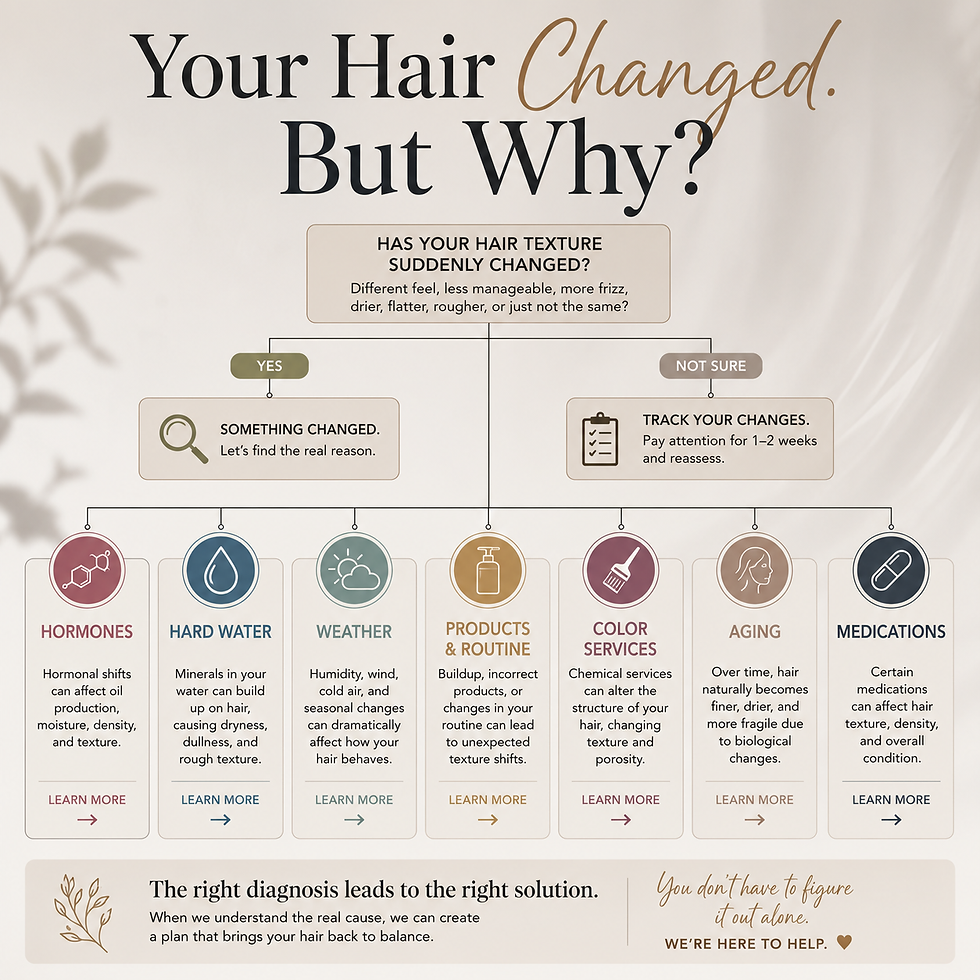
If your hair has changed in other ways too, Why Your Hair Suddenly Changed Texture explains why changes in hormones, damage, environment, products, and routine can affect the way your hair behaves.
Sometimes curl retention isn't equally poor everywhere. If one side of your hair holds curls better than the other, differences in technique, natural texture, damage, product distribution, or haircut weight may explain the imbalance.
1. Your Hair May Be Too Soft to Hold Shape
This sounds backwards.
Healthy hair is supposed to feel soft.
But extremely soft hair doesn't always behave the way you want it to.
If you've been using:
moisturizing shampoo
rich conditioner
weekly masks
leave-in conditioner
oils
smoothing creams
your hair may have become too weighed down or overly conditioned to maintain shape easily.
You curl it.
It looks beautiful.
Then gravity wins.
Ten minutes later, you're back where you started.
Common clues include:
curls fall almost immediately
roots feel flat
hair feels very silky
hair lacks body
natural waves appear stretched out
styling products seem to make it even flatter
This is one reason more conditioning isn't always the answer.
If your hair has become unusually soft, limp, or stretchy, Can You Over-Moisturize Your Hair? explains how too much conditioning can affect strength, volume, and the hair's ability to hold a style.
2. Product Buildup Can Literally Weigh Down the Curl
Sometimes the hair isn't too moisturized.
It's just carrying too much stuff.
Think about everything that can accumulate on your hair:
leave-in conditioner
oils
dry shampoo
heat protectant
smoothing cream
hairspray
mousse
texture spray
silicones
mineral deposits
None of those products is automatically bad.
But layers add up.
Eventually the hair may become heavier and less responsive to styling.
Natural curls can stretch.
Heat-styled curls can collapse.
Volume disappears.
And adding more styling product can make the problem even worse.
A useful clue:
If your hair feels coated, heavy, unusually smooth, or difficult to get truly clean, buildup deserves a closer look.
Sometimes the problem is much more specific: the curls hold through the lengths but collapse near the scalp. Why your curls fall flat at the roots explains how hair weight, density, product buildup, moisture balance, and drying technique can create that pattern.
Sometimes the biggest clue is that curls hold better on day two than immediately after washing. Why your hair holds curls better when it’s dirty explains how natural oils, leftover styling product, conditioner, and wash-day softness can change curl retention.
🌿 Free Hair Reset Guide
Stop Guessing. Start Understanding Your Hair.
If Your Hair Suddenly Stopped Holding Curls, Something Changed
It's easy to blame your curling iron, hairspray, or technique when curls suddenly stop lasting.
But changes in moisture balance, buildup, damage, water quality, hair texture, and your routine can all affect how well hair holds shape.
The Free Hair Reset Guide walks you through the five biggest factors affecting your hair so you can figure out what changed before buying stronger styling products or turning up the heat.
3. Damage Can Make Hair Harder to Style Predictably
Damaged hair doesn't always refuse to curl.
Sometimes it curls very easily.
But then it won't hold the curl.
Repeated exposure to:
bleach
chemical color
flat irons
curling irons
blow dryers
sunlight
mechanical wear
can change the structure and porosity of the strand.
Highly porous sections may react differently from healthier areas.
You may notice:
some pieces curl beautifully
other pieces go straight almost immediately
highlighted ends lose shape first
frizz develops while the curl falls
the finished style looks uneven
This is where the condition of the hair becomes more important than the styling tool.
If your hair also feels rough, brittle, stretchy, or unusually fragile, our Hair Health & Repair Guide explains how damage affects the structure of the strand and what damaged hair can realistically recover from.
4. Your Hair Texture May Have Changed
This one surprises people.
Hair texture isn't necessarily permanent.
It can change throughout life.
Hair may become:
finer
coarser
straighter
curlier
less dense
more porous
more resistant to styling
Those changes can affect how well it holds curls.
A technique that worked perfectly five years ago may not work the same way today because you're no longer styling exactly the same hair.
That's especially worth considering if you've also noticed changes in:
density
oil production
dryness
frizz
curl pattern
individual strand thickness
The styling technique may not be wrong.
It may simply need to catch up with your hair.
Porosity can influence curl retention, but it is only one piece of the puzzle. Does hair porosity affect how well hair holds curls? explains how high- and low-porosity hair can respond differently to moisture, products, and styling.
5. Humidity Can Undo a Curl Faster Than Your Styling Products Can Hold It
Humidity changes the relationship between hair and water in the air.
For some hair, humidity creates frizz.
For others, it causes carefully styled curls to loosen and collapse.
That's why a hairstyle that lasts all day in one environment may fall apart quickly somewhere else.
If your curls hold sometimes but disappear on humid days, don't automatically blame your curling iron.
Look at the weather.
If your hair seems to change from one day to another depending on the environment, why your hair feels dry one day and frizzy the next explains how humidity and weather can change the way hair behaves.
Humidity can be the specific reason curls hold well indoors but collapse outside. Why your curls fall out in humidity explains how moisture in the air, porosity, hair condition, and product support can change curl retention.
6. Your Haircut Can Change How Well Your Hair Holds Curls
Length matters.
Weight matters.
Layers matter.
If your hair has grown significantly longer, the extra weight can pull curls downward.
This is especially noticeable in:
fine hair
long hair
naturally wavy hair
hair with minimal layering
Sometimes the curling technique hasn't changed at all.
There's simply more hair pulling against the curl.
This is also why two people with similar hair texture can use the same curling iron and get completely different results.
The haircut is part of the styling system.
7. Turning Up the Heat Can Actually Make the Problem Worse
When curls stop holding, one of the first reactions is:
"Maybe I need more heat."
Be careful.
Increasing heat may temporarily create a stronger curl.
But repeated high temperatures can contribute to cumulative damage.
Eventually you're creating the exact problem you're trying to solve.
Hair becomes less predictable.
Ends become rougher.
Porosity becomes uneven.
Then you need even more styling effort to achieve the same result.
More heat isn't always more hold.
Sometimes it's just more stress on the strand.
Start Diagnosing the Pattern
Before changing your entire styling routine, ask:
Did my curls stop holding suddenly or gradually?
Is my hair much softer than it used to be?
Does it feel heavy or coated?
Have I added more masks, oils, or leave-ins?
Has my hair recently been colored or lightened?
Is the problem worse on humid days?
Are only the ends losing curl?
Has my haircut grown significantly longer?
Are my natural curls changing too?
Does my hair feel different even when I don't style it?
Those answers help separate a styling problem from a hair-condition problem.
And that's important.
Because stronger hairspray won't fix buildup.
More heat won't fix damage.
And another conditioning mask won't help hair that's already too soft.
What We'd Recommend in the Salon
This is one of those articles where the product recommendation depends heavily on why the curl stopped holding.
If Natural Waves or Curls Have Lost Definition
For naturally wavy or curly hair that has lost bounce and definition, Keune's Confident Curl range is a logical option.
The updated range uses Curlmax Technology and Amaranth Extract, and Keune specifically positions it to enhance curl definition and bounce while providing long-lasting frizz control and humidity protection.
Learn More & Shop Keune Confident Curl Shampoo
Learn More & Shop Keune Confident Curl Conditioner
I would only recommend this path when we're talking about natural waves or curls.
If naturally straight hair simply won't hold a curling-iron curl anymore, we'd diagnose the reason first rather than assuming a curl-care line is the answer.
If Buildup Is Weighing the Hair Down
When hair feels coated, heavy, or unusually flat, clarification may be a better first step than adding stronger styling products.
Keune Perfect Clarity is designed to deeply cleanse the hair and remove product buildup, which makes it relevant when accumulated products are interfering with volume and styling response.
Learn More & Shop Keune Perfect Clarity Shampoo
It's to understand why they stopped holding in the first place.
What to Do Next
If your hair suddenly stopped holding curls, don't immediately reach for:
stronger hairspray
a hotter curling iron
more mousse
more dry shampoo
another heavy mask
First, figure out what changed.
That gives you a much better chance of fixing the actual problem.
At-Home Support
1. Clarify if the Hair Feels Heavy or Coated
If your curls used to hold and now your hair feels:
heavier
flatter
unusually silky
coated
harder to get volume into
buildup may be contributing.
Clarifying can help when the evidence points toward residue or product weight.
But don't clarify aggressively just because curls aren't holding.
If your hair already feels dry, brittle, or damaged, over-cleansing can create a different problem.
2. Reduce Heavy Products for a Few Washes
For one or two styling cycles, simplify.
Try:
one shampoo
one conditioner
one lightweight leave-in if needed
one styling product
Skip the extra:
oils
masks
smoothing creams
layered leave-ins
Then see whether your hair responds differently.
Sometimes curls don't need stronger hold.
They need less weight.
3. Let the Curl Cool Before Touching It
This matters more than many people realize.
If you're using a curling iron, let the curl cool completely before brushing, separating, or running your fingers through it.
Heat creates the shape.
Cooling helps set it.
If you immediately loosen the curl while it's still warm, you may be undoing the shape before it has a chance to hold.
Affiliate Disclosure: Some links on this page are affiliate links. If you make a purchase through one of these links, Cache' Salon may earn a commission at no additional cost to you.
The Curling Iron Vivian Uses Behind the Chair
If your curls are falling flat, the tool can matter, but technique matters more. Use controlled heat, work in manageable sections, and let each curl cool before brushing or separating it.
Vivian uses the BaBylissPRO Nano Titanium Professional Long Barrel Curling Iron behind the chair at Cache' Salon.
We like that it is a professional tool our stylist actually works with, but we still recommend using the lowest effective temperature for your hair instead of automatically turning the heat all the way up.
→ Check the BaBylissPRO Nano Titanium Long Barrel Curling Iron on Amazon
4. Use Less Hair at a Time
Large sections create a softer, looser curl.
That may be exactly what you want.
But if the curl is disappearing too quickly, try slightly smaller sections.
The goal isn't tighter curls forever.
It's giving each section enough controlled heat to form a consistent shape.
5. Don't Keep Re-Curling the Same Section
If a curl falls flat, repeatedly heating it can seem like the obvious fix.
But more passes mean more heat exposure.
If a section refuses to hold despite proper technique, that can be useful information.
The issue may be the condition of the hair rather than your curling iron.
6. Watch What Happens on Humid Days
If your curls last well indoors but collapse quickly outside, weather may be part of the pattern.
Humidity doesn't affect every hair type the same way.
Track whether your styling problem changes with:
humidity
rain
dry weather
travel
seasonal shifts
Patterns matter.
Your Styling Technique May Need to Change With Your Hair
Sometimes nothing is "wrong."
Your hair has simply changed.
Maybe it's longer.
Maybe it's finer.
Maybe you've added layers.
Maybe you've colored it.
Maybe your texture has shifted.
That means the technique that worked years ago may no longer be the best technique today.
The tool hasn't necessarily failed.
The products haven't necessarily failed.
Your hair may just need a different approach.
Professional Guidance
If your hair consistently refuses to hold curls and the change seems significant, a professional consultation can help narrow down the cause.
At Cache' Salon, we'd look at:
buildup
moisture balance
elasticity
porosity
heat history
chemical history
current haircut
density
natural texture
product weight
changes in the hair over time
We'd also want to know whether you're talking about:
natural curls losing definition
or
heat-styled curls falling flat
Those are not always the same problem.
🌿 Free Hair Reset Guide
Stop Guessing. Start Understanding Your Hair.
If Your Curls Stopped Lasting, Don't Just Add More Hold
When hair suddenly stops holding curls, it's easy to blame the curling iron, hairspray, or styling technique.
But changes in buildup, moisture balance, damage, porosity, water quality, texture, and routine can all affect the way hair responds to styling.
The Free Hair Reset Guide walks you through the five biggest factors affecting your hair so you can understand what changed before turning up the heat or adding more products.
Professional Insight
When someone tells us:
"My hair used to hold curls all day and now it falls flat."
We don't automatically think:
"You need stronger hairspray."
We start looking for the change.
Did the hair become softer?
More porous?
More damaged?
Heavier?
Longer?
Did the client start using different products?
Did the water change?
Did the texture itself change?
Once we identify the pattern, the styling recommendation becomes much more useful.
The curl falling out is the symptom.
The reason behind it is what matters.
Hair Changes Can Happen Over Time
The American Academy of Dermatology notes that hair can become drier, thinner, and more fragile with age, while chemical processing and heat styling can also affect the condition and behavior of the hair.
That matters because hair that has changed internally may not respond to styling the same way it did several years ago.
Professional Service Options
Depending on what we find, professional recommendations may include:
Hair Consultation
Hair Health Evaluation
Clarifying Treatment
Conditioning or Bond-Support Treatment
Haircut or Layer Adjustment
Curl-Care Consultation
Customized Styling Routine
Home Care Recommendations
The right answer isn't always a treatment.
Sometimes it's a haircut adjustment.
Sometimes it's clarification.
Sometimes it's changing product weight.
Sometimes it's simply learning a styling technique that matches your hair today.
Stop Asking, "What Hairspray Will Make My Curls Stay?"
A better question is:
"Why did my hair stop holding curls?"
That's the question that actually gets you somewhere.
Because if the problem is buildup, stronger hairspray adds more buildup.
If the problem is damage, more heat adds more damage.
If the hair is already over-conditioned, another rich product may make it even flatter.
And if your texture has changed, using the exact same routine forever may never produce the same result.
Understand the change first.
Then adjust the technique.
Frequently Asked Questions
Why won't my hair hold curls anymore?
Common reasons include buildup, moisture imbalance, damage, changes in hair texture, humidity, product weight, hair length, and changes in styling technique.
Why do my curls fall out immediately?
The hair may be too soft, too heavy, overly coated with products, or not cooling long enough before being brushed or separated.
Can damaged hair stop holding curls?
Yes.
Damaged or highly porous sections can behave unpredictably and may not maintain a consistent curl as well as healthier areas.
Can too much conditioner make curls fall flat?
It can.
Heavy conditioning or product layering may make some hair too soft or weighed down to maintain volume or shape effectively.
Can buildup stop hair from holding curls?
Yes.
Accumulated oils, leave-ins, silicones, styling products, and mineral deposits can add weight and interfere with styling response.
Why don't my natural curls hold anymore?
Changes in moisture balance, buildup, damage, hormones, hair length, product weight, and natural texture can all affect curl definition.
Does humidity make curls fall out?
It can.
Humidity can change how hair interacts with moisture in the air, causing curls to loosen, frizz, or lose definition.
Should I turn up my curling iron temperature?
Not automatically.
Higher heat may create a stronger temporary curl, but repeated excessive heat can contribute to damage over time.
Does hair length affect curl hold?
Yes.
Longer hair has more weight pulling on the curl, which can make curls loosen faster, especially in fine or naturally wavy hair.
When should I ask a stylist for help?
If your hair's styling behavior changed significantly, your curls no longer respond to techniques that used to work, or the hair also feels damaged, heavy, brittle, or unusually different, a professional consultation can help identify the likely cause.
Want help choosing the right pro products for your hair? Explore our Keune Experience.
Written by Tammy Brown
Owner of Cache' Salon in Hanford, CA
18-year cosmetologist specializing in color, transformations, and education.


Comments