

Can Hair Porosity Change Over Time? 7 Reasons Your Hair May Suddenly Behave Differently | Cache' Salon Hanford


Can Hair Porosity Change Over Time? 7 Reasons Your Hair May Suddenly Behave Differently
Maybe your hair used to absorb conditioner easily, but now products seem to sit on top of it. Or your ends suddenly soak up everything while your roots behave completely differently.
That can make it feel like your hair type somehow changed.
In some cases, something actually has changed.
Hair porosity isn't necessarily identical throughout every strand or constant over the lifetime of the hair on your head. Bleaching, chemical services, repeated heat, UV exposure, friction, and normal weathering can alter the structure of existing hair fibers. At the same time, buildup, hard water, humidity, and product changes can make your hair behave differently without necessarily changing its underlying porosity.
Understanding the difference matters because treating every dryness, frizz, or product problem as a "porosity problem" can send you in the wrong direction.
Quick Answer: Can Hair Porosity Change Over Time?
Yes. The porosity of an existing hair fiber can change as that fiber accumulates chemical, thermal, mechanical, and environmental damage.
The important distinction is that your hair doesn't all have the same history. New growth near your scalp may be relatively untouched while your ends may have experienced years of coloring, heat styling, sunlight, washing, brushing, and friction.
That means different sections of the same head of hair can behave very differently.
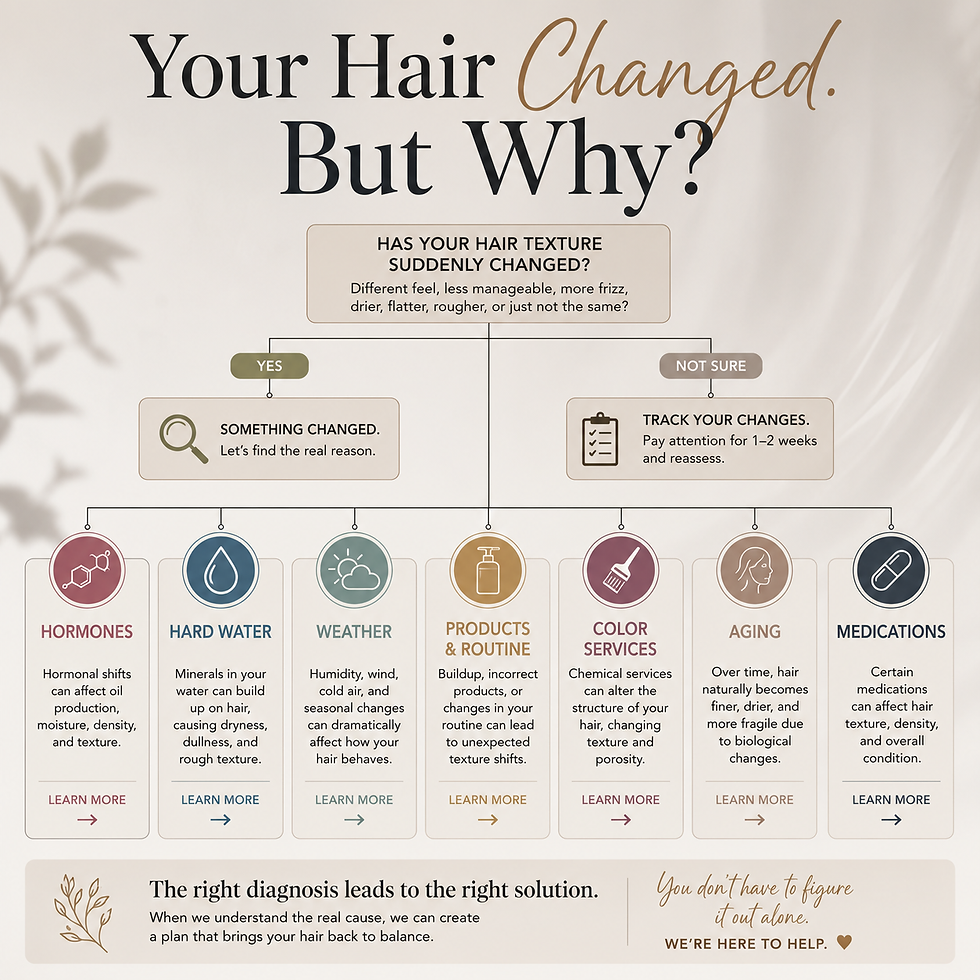
If you've noticed broader changes in texture, manageability, or how your hair responds to your normal routine, read our guide to why your hair suddenly changed texture. It looks at several of the bigger reasons hair can begin behaving differently.
What Does Hair Porosity Actually Mean?
Hair porosity is generally used to describe how readily the hair interacts with and takes up moisture and other substances.
The cuticle, which forms the outer protective surface of the hair fiber, plays an important role.
When the cuticle is relatively intact, it helps protect the cortex underneath and contributes to a smoother hair surface. When that protective structure becomes increasingly weathered or damaged, the fiber can interact with water differently and may become rougher, weaker, more difficult to manage, or more prone to breakage.
This is one reason we don't like reducing porosity to a simple label of "low," "medium," or "high."
The more useful question is:
Why is your hair behaving this way now?
That gives us much more information about what to do next.
Why Can Hair Porosity Change?
There isn't one single cause.
An existing strand of hair can accumulate wear throughout its lifetime, and several things can accelerate that process.
1. Bleaching can significantly alter the hair fiber
Bleaching is one of the clearest examples.
Bleach needs to create significant chemical changes within the hair to lighten its natural pigment. Those changes don't simply disappear when you leave the salon.
Research examining bleached hair has found structural changes to both the cuticle and cortex. Excessive bleaching can produce damaged or separated cuticle cells and increased porosity within the cortex.
That doesn't mean everyone who highlights their hair has unhealthy hair.
It means chemical history matters.
Hair that has been lightened repeatedly may not interact with water, humidity, styling products, or heat the same way it did before those services.
That's also why we look at the history of the hair before deciding what it needs.
2. Repeated heat can contribute to structural changes
Heat styling isn't automatically bad.
Temperature, frequency, technique, the condition of the hair, and whether the hair has already been chemically treated all matter.
Research has found that thermal stress can affect the cuticle and internal structure of hair, with chemically treated fibers being particularly vulnerable to additional heat-related changes.
So if someone tells us:
"My hair was fine for years, but lately my ends feel rough and nothing works anymore,"
one of the questions we're going to ask is how often they're blow-drying, curling, or flat ironing and at what temperature.
The issue may not be one dramatic event.
It may be accumulation.
3. Your hair naturally accumulates wear as it gets older
This is one of the most overlooked pieces of the porosity conversation.
The hair at your ends is older than the hair at your roots.
That sounds obvious, but it has important consequences.
This isn't just a salon observation. Research into the structure and weathering of human hair describes weathering as progressive damage that occurs from the root toward the tip of the hair. Chemical treatments, grooming, heat, and environmental exposure can all contribute, which helps explain why older ends may behave very differently from newer growth.
Imagine someone with long highlighted hair.
Her roots might be only a few months old.
Her ends might be several years old.
Those ends have lived through far more shampoos, blowouts, ponytails, nights on a pillow, summers in the sun, color appointments, and passes with a hot tool.
There is no reason to expect those two sections to behave identically.
Can Your Roots and Ends Have Different Porosity?
Absolutely.
In fact, this can explain a lot of frustrating hair problems.
You may notice that:
your roots take forever to get fully wet while your ends get wet immediately
conditioner feels heavy near your scalp but disappears into your ends
your ends dry faster than the rest of your hair
your roots feel smooth while your ends feel rough
one section frizzes dramatically while another doesn't
your ends need more conditioning than your new growth
That doesn't necessarily mean you need to choose one porosity label for your entire head.
Your hair may simply have different histories along the same strand.
This is also why we don't love universal routines based entirely on a porosity quiz.
Sometimes your roots and ends shouldn't be treated exactly the same way.
Does High-Porosity Hair Always Mean Your Hair Is Damaged?
No.
Porosity and damage overlap, but they aren't interchangeable terms.
Some hair naturally behaves in ways associated with higher porosity. Texture, curl pattern, previous services, environmental exposure, and the current condition of different sections of hair can all affect what you're experiencing.
Damage can certainly increase porosity, particularly when the cuticle and other structural components of the hair have been altered.
But simply deciding that "high porosity equals damaged hair" is too simplistic.
We've broken this distinction down further in whether high-porosity hair means damaged hair, including the signs we would look for before assuming damage is the cause.
Can Your Hair Seem More Porous Without Its Porosity Actually Changing?
Yes, and this is where porosity advice online can get messy.
Not every sudden change in how your hair behaves means its physical structure has dramatically changed.
Several other problems can create similar symptoms.
Product buildup
If styling products, conditioners, oils, dry shampoo, or other materials accumulate on the hair, water and products may stop behaving the way you expect.
You might conclude:
"My hair became low porosity."
But the bigger issue may be what's sitting on the hair rather than a fundamental change inside it.
If products that used to work suddenly seem useless, our guide to why your hair slowly stops responding to products can help you separate buildup from other changes.
Can Hard Water Make It Seem Like Your Porosity Changed?
Yes, and this is an important distinction.
Hard water contains higher concentrations of dissolved minerals. Over time, mineral accumulation can affect how hair feels and how well your normal routine seems to work.
You might notice hair that feels:
coated or waxy
dull
rough
unusually stiff
harder to lather or cleanse
less responsive to products that used to work
Those symptoms can make it tempting to decide that your hair suddenly became more or less porous.
But the underlying problem may be your water rather than a major structural change in your hair.
This is especially worth investigating if the change began after moving, traveling, installing a new water system, or spending significant time somewhere with different water.
Affiliate Disclosure: Some links on this page are affiliate links. If you make a purchase through one of these links, Cache' Salon may earn a commission at no additional cost to you.
Not Sure If Your Water Is Hard?
You don't need to buy a shower filter or water softener just because your hair feels different.
Test first.
A simple water-hardness test can help you determine whether hard water is even worth investigating before you spend money trying to solve it.
Check Your Water Hardness at Home
If testing confirms hard water, then it makes sense to look more closely at the water itself and whether filtration, softening, or changes to your hair routine are appropriate.
🌿 Not Sure What's Actually Making Your Hair Behave Differently?
Porosity is only one possibility.
If your hair suddenly feels dry, waxy, rough, tangled, frizzy, or just doesn't respond to your normal routine anymore, adding another product may make it harder to figure out what's happening.
Our free Hair Reset Guide helps you simplify the variables and start identifying what changed before you decide what your hair needs next.
Humidity and weather
Hair can behave completely differently as environmental conditions change.
Humidity can make certain hair swell and frizz, while dry conditions can leave it feeling rough or dehydrated.
That doesn't mean your hair's underlying structure completely changes every time the weather does.
If this sounds familiar, we've explained why your hair feels dry one day and frizzy the next and what weather may actually be doing to it.
A routine that no longer matches your hair
Sometimes the routine didn't change.
The hair did.
If you've added highlights over the last year, grown your hair significantly longer, increased heat styling, changed your color, or simply accumulated more weathering on your ends, the routine that worked two years ago may no longer match the hair you have today.
That's different from saying your shampoo suddenly "stopped working."
The context changed.
Does Sun Exposure Affect Hair Porosity?
It can contribute to the weathering process.
UV exposure can cause physical and chemical changes to hair fibers. Published research describes effects including increased surface roughness, reduced mechanical strength, and increased fiber porosity associated with photochemical damage.
Again, the useful concept is accumulation.
One afternoon outside isn't the same thing as years of repeated exposure.
Your hair records its history.
And unlike skin, the visible hair shaft doesn't heal itself biologically once it has been structurally damaged.
We can improve how damaged hair feels, reduce additional stress, condition it, protect it, and make it significantly more manageable.
We can't make an old damaged fiber become brand-new hair again.
How Can You Tell If Your Hair Porosity Actually Changed?
We wouldn't start with the popular glass-of-water test.
We would start with your hair's history.
Ask yourself:
When did the change begin?
Did it happen suddenly, or has it gradually become more noticeable?
Where is the problem?
Is your entire head behaving differently, or mostly the mid-lengths and ends?
What chemical services has this section of hair experienced?
Highlights, bleach, permanent color, chemical straightening, and perms matter.
Has your heat routine changed?
Consider both frequency and temperature.
Do products absorb differently than they used to?
Or do they seem to coat the hair?
Does your hair feel rough, brittle, weak, stretchy, gummy, heavy, waxy, or simply dry?
Those descriptions are not interchangeable.
Did the problem begin after moving or traveling?
Water deserves consideration.
Does it change dramatically with the weather?
Humidity may be contributing.
Are your roots healthier than your ends?
That points us toward the history of the older hair fiber.
This is much more useful information than simply declaring your hair "high porosity."
Professional Insight: Don't Treat the Porosity Label Before You Find the Cause
At Cache', this is where we would slow the conversation down.
Two clients can both tell us:
"My hair is really porous."
And we may give them completely different advice.
One might have repeatedly lightened ends that are becoming dry and fragile.
Another might have healthy hair covered in product or mineral accumulation.
Another might have changed her routine and started using products that are too heavy.
Another might primarily be experiencing humidity-related frizz.
If we give all four people the same "high-porosity routine," we're ignoring the most useful information.
The goal isn't to treat a porosity label. The goal is to understand why your hair is behaving differently.
What Should You Do If Your Hair Porosity Seems to Have Changed?
Start with the cause rather than immediately replacing every product you own.
At-Home Support
First, look at what has changed during the same period your hair changed.
Consider:
recent highlighting or bleaching
more frequent hot-tool use
higher heat settings
increased hair length
changes in water
new styling products
heavier conditioning products
changes in climate or humidity
more swimming or sun exposure
increased friction from styling or sleeping habits
Then simplify.
If you're using several masks, oils, leave-ins, creams, and styling products because your hair feels dry, adding another product isn't automatically the answer.
Sometimes we need to remove variables before adding more.
Also pay attention to different sections of your hair.
Your roots may not need what your ends need.
Professional Guidance
If your hair is increasingly brittle, breaking, unusually stretchy when wet, difficult to detangle, or dramatically different after chemical services, a professional assessment can help.
This is especially important before another major chemical service.
Sometimes the best thing we can do for the hair isn't another treatment.
It may be adjusting the color plan, extending the time between lightening services, changing heat habits, trimming compromised ends, or rebuilding the home-care routine.
For a broader look at damaged and unhealthy hair, our Hair Health & Repair Guide explains how we separate dryness, dehydration, breakage, chemical damage, and other common problems.
What We'd Recommend in the Salon
We wouldn't recommend a product simply because someone says they have "high-porosity hair."
We'd first look at what the hair is actually doing.
If the hair is becoming dry, fragile, or prone to breakage
We may look at Keune Vital Nutrition.
The current Vital Nutrition line is designed for dry hair, with Keune positioning it around nourishment, hydration, repair, and strengthening. Keune's current testing reports
increased nourishment and reduced breakage when the specified product routine is used.
For someone whose older or chemically processed sections are becoming increasingly dry and fragile, that's a much more useful reason to choose Vital Nutrition than simply seeing "high porosity" on a quiz.
Learn More & Shop Keune Vital Nutrition Shampoo and Conditioner
If roughness and frizz are the bigger problem
We may instead look at Keune Velvet Smooth.
Velvet Smooth is designed for frizz control and smoothing. Keune's current documentation reports improvements in smoothness and frizz under its specified testing conditions.
Again, the symptom leads the recommendation.
Learn More & Shop Keune Velvet Smooth
If neither description matches your hair, we wouldn't force either product.
Sometimes the correct first step is figuring out whether you're dealing with damage, buildup, water, heat, or simply a routine that no longer fits.
🌿Free Hair Reset Guide
Stop Guessing. Start Understanding Your Hair.
If Your Hair Suddenly Behaves Differently, Start With the Reason
If products absorb differently, your ends suddenly feel rough, or the routine you've used for years no longer seems to work, don't assume you need to buy an entirely new routine.
Dryness, damage, buildup, hard water, heat, chemical services, and changing hair needs can produce symptoms that look surprisingly similar.
Our free Hair Reset Guide helps you step back, simplify what you're doing, and start figuring out what your hair may actually be telling you.
The Bottom Line
Yes, hair porosity can change over time.
But that doesn't mean every change in your hair is a porosity change.
Bleaching, repeated chemical services, heat, UV exposure, friction, and normal weathering can alter existing hair fibers. That's also why your older ends can behave very differently from newer growth.
Buildup, water quality, humidity, and an outdated routine can create similar symptoms without necessarily meaning your hair suddenly became structurally more or less porous.
So if your hair doesn't behave the way it used to, don't start with:
"What porosity am I?"
Start with:
"What changed?"
That's usually where the useful answer begins.
Frequently Asked Questions
Can hair go from low porosity to high porosity?
An existing hair fiber can become more porous as its structure is altered by factors such as bleaching, chemical processing, heat, UV exposure, and accumulated weathering.
That doesn't necessarily mean every strand on your head changed equally.
Can bleached hair become more porous?
Yes. Bleaching can alter both the cuticle and internal structure of hair, and research has documented increased porosity and structural damage in bleached fibers.
Can you have low-porosity roots and high-porosity ends?
Yes. Your roots are newer hair while your ends are older and may have accumulated considerably more chemical, thermal, mechanical, and environmental exposure.
Does heat change hair porosity?
Repeated or excessive heat can damage hair structure, and chemically treated hair may be especially susceptible to additional thermal damage. How much it matters depends on temperature, frequency, technique, and the existing condition of the hair.
Can hard water change hair porosity?
Hard water can change how hair feels and behaves because of mineral accumulation, but that doesn't automatically mean the underlying structure of the hair became more porous. That's why it's important to distinguish environmental buildup from structural damage.
Can product buildup make hair seem low porosity?
It can make products and water behave differently on the hair, which may be interpreted as a porosity change. If the change happened without an obvious chemical or heat-related cause, buildup is one of the things worth investigating.
Can you permanently fix high-porosity hair?
If increased porosity is the result of structural damage to an existing hair fiber, products can improve conditioning, manageability, smoothness, and protection, but they don't turn that old fiber into newly grown, undamaged hair. The long-term strategy is to improve how the existing hair is cared for while protecting healthier new growth.
Why are my ends more porous than my roots?
Your ends are older. They may have experienced years more washing, brushing, friction, sunlight, heat styling, coloring, and chemical services than the hair near your scalp. Hair weathering tends to accumulate along older portions of the fiber.
Should I choose products based only on my hair porosity?
We wouldn't. Porosity can be useful information, but dryness, damage, buildup, water quality, chemical history, heat habits, texture, and the condition of different sections of your hair can be just as important when choosing a routine.
Want help choosing the right pro products for your hair? Explore our Keune Experience.
Written by Tammy Brown
Owner of Cache' Salon in Hanford, CA
18-year cosmetologist specializing in color, transformations, and education.


Comments