

Why Your Hair Feels Like Straw—And How to Make It Soft Again | Cache' Salon Hanford

Updated: Sep 6
Why Your Hair Feels Like Straw—And How to Make It Soft Again
You wash your hair.
You condition it.
Maybe you even use a deep conditioning mask every week.
But when your hair dries, it feels stiff.
Rough.
Almost like straw.
You reach for another oil.
Another mask.
Another "repair" product.
Yet nothing seems to make your hair feel healthy again.
If that sounds familiar, the problem may not simply be that your hair is "dry."
Hair that feels like straw is often trying to tell you something much more specific. The challenge isn't finding another product. It's identifying why your hair suddenly feels different before choosing one.
The key is figuring out why before trying to fix it.
Quick Answer: Why Does My Hair Feel Like Straw?
Hair that feels like straw is usually a sign that the hair fiber has lost softness, flexibility, or its ability to retain moisture. This can happen because of dehydration, damage from heat or chemical services, mineral buildup from hard water, excessive cleansing, or an imbalance between moisture and strengthening products. Although all of these problems can make hair feel rough, they require different solutions. The best way to improve straw-like hair is to identify the underlying cause before adding more products.
Start Here: Match the Fix to What Your Hair Feels Like
If your hair feels dry, rough, and less flexible, we often recommend Keune Care Vital Nutrition Shampoo & Conditioner.
If it feels coated, stiff, or like conditioner isn’t helping, buildup may be the problem. In that case, Keune Care Perfect Clarity Shampoo is often the better starting point.
If it feels rough when dry but softer when wet, a leave-in like Keune Care Velvet Smooth 2-Phase Spray can help reduce friction and improve smoothness.
If you’re not sure which description fits, keep reading. Straw-like hair can come from very different causes, and the wrong product can make the problem harder to diagnose.
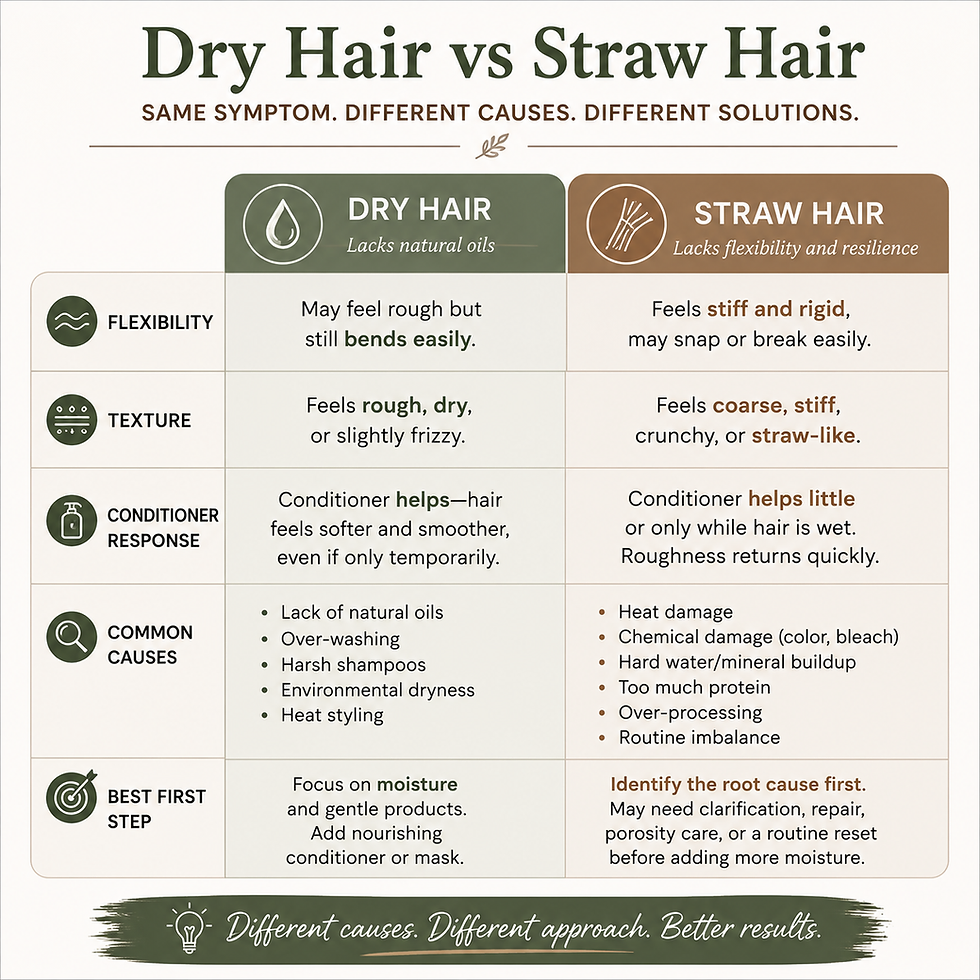
Hair That Feels Like Straw vs. Hair That's Simply Dry
Hair Feels Dry | Hair Feels Like Straw |
Rough | Rough and rigid |
Needs more softness | Feels stiff and inflexible |
Often responds to conditioner | Often stays rough even after conditioning |
Usually lacks moisture | May involve damage, buildup, dehydration, or over-processing |
Can improve fairly quickly | Usually requires diagnosing the underlying cause |
One of the biggest mistakes people make is assuming every rough texture means their hair needs another moisturizing treatment.
Sometimes that's true.
Sometimes it actually makes the problem worse.
Why Straw-Like Hair Happens
Healthy hair should feel flexible.
It should bend without snapping.
It should glide between your fingers instead of catching on every strand.
When hair starts feeling like straw, something has changed.
That change usually falls into one of five categories:
moisture loss
dehydration
damage
buildup
routine imbalance
The challenge is that all five can feel surprisingly similar.
That's why so many people spend months—or even years—trying products that never solve the real issue.
If you're still trying to figure out which symptom best matches what you're experiencing, our Hair Problems Resource Center organizes the most common concerns—from straw-like and dry hair to waxy, greasy, tangled, and dull hair—so you can narrow down the most likely cause before changing your routine.
🌿 Still Not Sure Which Problem You Actually Have?
Hair that feels like straw isn't always caused by dryness.
Sometimes it's buildup.
Sometimes it's damage.
Sometimes it's simply the wrong routine.
The Free Hair Reset Guide walks you through the five biggest factors affecting your hair so you can stop guessing and start understanding what your hair is actually trying to tell you.
1. Your Hair May Be Dehydrated
Many people use the words "dry" and "dehydrated" interchangeably.
They're not the same thing.
Dry hair lacks enough natural oil.
Dehydrated hair lacks water.
Hair that's dehydrated often feels:
rough
dull
frizzy
stiff
harder to detangle
softer while wet than after it dries
One clue is that conditioner helps—but only temporarily.
Your hair may feel soft in the shower but become rough again within an hour.
That's because oils smooth the surface.
They don't replace water inside the strand.
If you're unsure which one you're experiencing, our guide to dehydrated hair vs. dry hair explains the difference and helps you determine which problem your hair is more likely experiencing.
2. Heat Damage Can Make Hair Feel Like Straw
Repeated heat styling gradually changes the outer protective layer of the hair.
Flat irons.
Curling irons.
High blow-dryer temperatures.
Even frequent hot brushes.
Over time, the cuticle becomes rougher.
Instead of reflecting light smoothly, the hair begins catching on itself.
That's why damaged hair often feels:
coarse
rough
brittle
dry
less flexible
more tangled
The American Academy of Dermatology notes that excessive heat styling is one of the most common causes of dry, brittle hair because repeated high temperatures weaken the protective outer layer of the strand.
A helpful clue:
If only the oldest ends feel like straw while your roots still feel relatively healthy, accumulated heat damage may be contributing.
3. Lightening and Color Services Can Increase Porosity
Healthy color services shouldn't automatically leave hair feeling like straw.
But repeated lightening or overlapping bleach can increase porosity.
Highly porous hair loses moisture more easily.
It also struggles to hold onto the moisture it does receive.
That creates a frustrating cycle.
The hair feels soft immediately after conditioning.
Then rough again a few hours later.
This doesn't necessarily mean your stylist did something wrong.
It often reflects the cumulative history of the hair rather than one appointment.
If your straw-like texture is concentrated in highlighted sections or older blonde pieces, our Hair Health & Repair Guide explains how damage changes the structure of the strand and what improvements are realistically possible.
4. Hard Water Can Leave Hair Feeling Like Straw
One of the most overlooked causes of straw-like hair is hard water.
Minerals such as calcium and magnesium can build up on the surface of the hair over time.
Instead of allowing conditioner to coat the strand evenly, mineral deposits create a rough surface that makes hair feel:
stiff
coated
dull
rough
tangled
difficult to soften
Adding richer conditioners often doesn't solve the problem.
In fact, it can make the hair feel heavier while the underlying roughness remains.
A simple clue:
Does your hair feel noticeably softer when you're traveling?
If so, your water—not your products—may be part of the problem.
Affiliate Disclosure: Some links on this page are affiliate links. If you make a purchase through one of these links, Caché Salon may earn a commission at no additional cost to you.
Not Sure If Hard Water Is Contributing to the Roughness?
Before adding another mask, oil, or repair product, it can help to rule out the water itself.
If your home has elevated calcium and magnesium levels, mineral buildup may be contributing to hair that feels stiff, coated, dull, or difficult to soften.
We recommend Varify Water Hardness Test Strips as an inexpensive way to check your water at home before spending money on filtration or a water softener.
→ Check the Varify Water Hardness Test Strips on Amazon
5. Too Much Repair Can Make Hair Feel Hard
More repair isn't always better.
Many strengthening products contain proteins or bond-support ingredients designed to reinforce weakened hair.
They're incredibly useful when the hair needs them.
But layering several strengthening products together can sometimes leave hair feeling:
rigid
rough
stiff
difficult to comb
less flexible
This is especially common when a routine includes:
strengthening shampoo
protein conditioner
repair mask
bond-building treatment
strengthening leave-in
The goal isn't to avoid these products.
The goal is balance.
If your routine contains multiple strengthening products, simplify it before assuming you need even more repair.
How to Start Narrowing Down the Cause
Before buying another product, ask yourself a few questions.
Does your hair feel rough immediately after shampooing?
Does conditioner help only while your hair is wet?
Are only the ends affected?
Did the problem begin after coloring or bleaching?
Did it begin after changing products?
Does your hair feel softer when traveling?
Does it snap easily—or simply feel rough?
Those answers often tell us much more than the texture alone.
In fact, many clients discover the issue isn't "straw hair" at all.
It's a completely different problem wearing the same disguise.
If you're still unsure, how to know if your hair needs clarifying, moisture, or repair walks you through the same thought process we use during professional consultations.
What to Do Next
Before changing your entire routine, take a step back.
Hair that feels like straw isn't a diagnosis.
It's a symptom.
The goal is to identify why it's happening so you can choose the right solution instead of treating the wrong problem.
At-Home Support
1. Simplify Your Routine for One Week
If you're currently rotating between multiple shampoos, masks, oils, leave-ins, and repair treatments, simplify everything.
For one week, try using:
one gentle shampoo
one conditioner
one leave-in product (if needed)
no repair masks
no protein treatments
no additional oils until your hair is dry
This gives your hair—and you—a chance to see what it's actually doing without several products masking the clues.
2. Wash Your Scalp, Not Your Hair
Many people scrub shampoo through the entire length of their hair every wash.
Most of the cleansing only needs to happen on the scalp.
Allow the shampoo to rinse through the mid-lengths and ends rather than aggressively washing them every time.
This simple change alone often reduces roughness in longer hair.
3. Turn Down the Heat
Heat doesn't just come from flat irons.
It also comes from:
blow dryers
curling irons
hot brushes
very hot shower water
Lower temperatures help preserve flexibility within the hair fiber.
Affiliate Disclosure: Some links on this page are affiliate links. If you make a purchase through one of these links, Caché Salon may earn a commission at no additional cost to you.
A Gentler Towel Can Help Protect Rough Hair
If your hair already feels stiff, rough, or straw-like, aggressive towel drying can add more friction and make the surface feel even rougher as it dries.
We recommend the Hicober Microfiber Hair Towel 3-Pack as an inexpensive way to absorb excess water without rubbing or twisting the hair as aggressively as a traditional bath towel.
→ Check the Hicober Microfiber Hair Towel 3-Pack on Amazon
4. Give Conditioner Time to Work
Conditioner isn't instant.
Apply it to the mid-lengths and ends.
Comb it through if appropriate for your hair type.
Leave it on for several minutes before rinsing.
Many people rinse before conditioning ingredients have enough time to coat the strand evenly.
5. Don't Assume You Need More Moisture
This is one of the biggest mistakes we see.
Hair that feels like straw may actually need:
clarification
less protein
less heat
fewer products
a trim
Adding another heavy conditioning mask every few days may make the hair feel coated without making it healthier.
6. Pay Attention to Patterns
Instead of asking:
"What product should I buy?"
Ask questions like:
Does my hair feel worse immediately after shampooing?
Is it only rough on the ends?
Does humidity help?
Does traveling change it?
Does conditioner help for only a few hours?
Patterns reveal causes.
Products rarely do.
Professional Guidance
Sometimes the problem isn't obvious from home.
At Cache' Salon, we don't start by recommending products.
We start by asking questions.
Questions like:
When did the texture change?
Has your hair recently been colored or lightened?
Has your water changed?
Has your styling routine changed?
Are only certain sections affected?
Does the hair feel coated—or simply rough?
We also evaluate:
porosity
elasticity
mineral buildup
breakage patterns
chemical history
heat exposure
the condition of the ends
overall moisture balance
Two clients can both describe their hair as "feeling like straw."
One may need clarification.
One may need moisture.
Another may simply need a haircut because the damaged ends can no longer be restored.
The goal isn't to sell the biggest treatment.
It's to identify what your hair is actually asking for.
What We'd Recommend in the Salon
If someone came into Cache' Salon because their hair suddenly felt like straw, we wouldn't automatically recommend the richest conditioner on the shelf. We'd first determine whether the rough texture was being caused by moisture loss, mineral buildup, heat damage, or an unbalanced routine, then recommend products that match the underlying cause instead of simply treating the symptom.
These are the products we most commonly recommend depending on what we find.
If your hair feels dry, rough, and less flexible
When straw-like hair is caused by moisture loss or damage, one of the first routines we often recommend is Keune Care Vital Nutrition Shampoo & Conditioner.
The updated formulas contain Immortelle Extract and Biomimetic Ceramides to replenish essential lipids, strengthen damaged strands, and improve moisture retention. Keune's testing found hair was 77% more nourished with 84% less breakage as part of the Vital Nutrition routine.
→ Learn More & Shop Vital Nutrition Shampoo
If your hair feels coated and conditioners don't seem to help
Sometimes straw-like hair isn't lacking moisture at all. Mineral buildup and product residue can leave the hair feeling rough while preventing conditioners from working properly.
In those situations, we often recommend Keune Care Perfect Clarity Shampoo to deeply cleanse the hair and remove buildup before returning to a nourishing routine. It's designed to remove product buildup, exfoliate the scalp, and prepare the hair for future salon treatments.
→ Learn More & Shop Perfect Clarity Shampoo
If your hair feels softer when wet but frizzy after it dries
When the cuticle has become rough from heat styling or increased porosity, we often recommend Keune Care Velvet Smooth 2-Phase Spray.
Its updated formula helps reduce frizz by up to 70%, provides 48-hour anti-frizz protection, and improves smoothness without weighing the hair down, making it a great choice for hair that feels rough as it dries.
→ Learn More & Shop Velvet Smooth 2-Phase Spray
Not sure which routine your hair actually needs?
Before purchasing new products, download our free Hair Reset Guide to better understand what's actually causing your hair to feel rough, stiff, or straw-like. The right routine starts with the right diagnosis.
🌿 Free Hair Reset Guide
Stop Guessing. Start Understanding Your Hair.
Hair That Feels Like Straw Usually Has a Story
Hair doesn't suddenly become straw-like for no reason.
Sometimes it's dehydration.
Sometimes it's hard water.
Sometimes it's years of heat styling, repeated lightening, or simply a routine that's no longer working for your hair today.
Our Free Hair Reset Guide walks you through the five biggest factors affecting your hair so you can understand what's changed, simplify your routine, and make more confident decisions before buying another product.
Professional Insight
One thing we've learned after thousands of consultations is that clients are usually very good at describing what their hair feels like.
They're just not always describing the cause.
Someone says:
"My hair feels like straw."
What we hear is:
"Something about the hair fiber has changed."
From there we begin narrowing down possibilities.
Is the roughness throughout the entire head?
Only the highlighted pieces?
Only the oldest ends?
Does the hair soften after conditioning?
Does it remain stiff?
Does it improve after clarification?
Those answers tell us far more than the word "straw" ever could.
That's why two people with nearly identical symptoms often leave with completely different recommendations.
Professional Service Options
Depending on what we find, professional recommendations may include:
Hair Health Consultation
Clarifying Service
Moisture-Focused Conditioning Treatment
Bond-Building Treatment
Customized Home Care Recommendations
Haircut to Remove Severely Compromised Ends
Color Consultation
Scalp Evaluation
Not every rough strand needs an intensive treatment.
Sometimes the biggest improvement comes from changing a routine—not adding another product.
Stop Asking, "How Do I Make My Hair Softer?"
A better question is:
Why did my hair stop feeling soft in the first place?
That's the question that changes everything.
Because hair that feels like straw isn't one problem.
It's several different problems that happen to feel very similar.
Once you understand what's actually causing the roughness, your next step becomes much clearer.
Understanding your hair comes before choosing products.
Explore our Hair Health Service Options
Frequently Asked Questions
Why does my hair feel like straw after washing?
The most common causes include dehydration, damage, hard-water buildup, excessive cleansing, and too much strengthening care. The texture alone doesn't identify which one is responsible.
Can damaged hair feel like straw?
Yes.
Heat damage, bleach, repeated coloring, and mechanical wear can all reduce flexibility and make hair feel rough, brittle, and straw-like.
Does hard water make hair feel like straw?
It can.
Mineral buildup may leave hair feeling rough, coated, dull, and difficult to soften—even with conditioner.
Can too much protein make hair feel stiff?
Yes.
While protein is beneficial when the hair needs it, layering multiple strengthening products together can sometimes leave hair feeling rigid or inflexible.
Why is my hair soft when it's wet but rough after it dries?
Water and conditioner temporarily increase slip.
Once the hair dries, dehydration, damage, porosity, or buildup may become more noticeable.
Can conditioner fix straw-like hair?
Sometimes.
But if buildup, damage, or excessive protein is the underlying issue, conditioner alone may not permanently improve the texture.
Should I use a deep conditioning mask?
Only if moisture loss appears to be part of the problem.
If the roughness comes from buildup or too much protein, another heavy mask may not help.
Does straw-like hair always need to be cut?
Not always.
Many cases improve with the right routine.
However, severely damaged ends may never fully regain their original softness and may eventually need trimming.
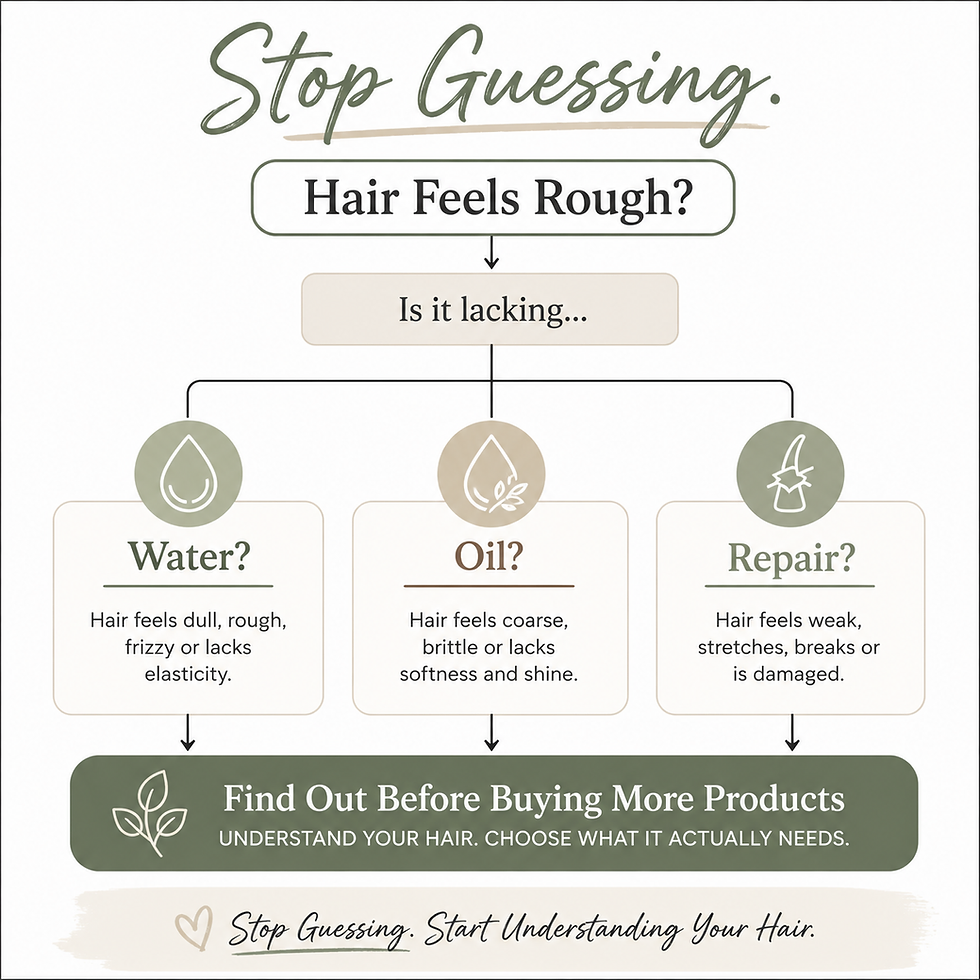
How do I know if my hair needs moisture, clarification, or repair?
The answer depends on how the hair behaves—not just how it feels.
That's why we recommend looking at the overall pattern rather than relying on one symptom.
Want help choosing the right pro products for your hair? Explore our Keune Experience.
Written by Tammy Brown
Owner of Cache' Salon in Hanford, CA
18-year cosmetologist specializing in color, transformations, and education.


Comments