

Why Does My Hair Suddenly Feel Thinner? How to Tell What's Really Changed | Cache' Salon Hanford

Updated: Oct 21

Why Does My Hair Suddenly Feel Thinner? How to Tell What's Really Changed
You run your fingers through your hair, and something feels different.
Your ponytail doesn't feel as full.
Your hair seems flatter than it used to.
Maybe you're noticing more strands in the shower. Or perhaps your hair looks perfectly normal, but when you gather it together, there simply doesn't seem to be as much of it.
And the confusing part?
You haven't necessarily changed anything.
When hair suddenly feels thinner, it's easy to assume you're losing hair. But hair feeling thinner and actually losing hair aren't always the same thing.
The difference matters because the right next step depends on what's changing.
Quick Answer: Why Does My Hair Suddenly Feel Thinner?
Hair can suddenly feel thinner because of increased shedding, breakage, changes in individual strand thickness, or a loss of volume caused by oil, buildup, or styling habits. Hormonal changes, illness, stress, medications, and nutritional factors can also affect hair growth and shedding.
The most important distinction is whether you have fewer hairs growing from your scalp, more hairs breaking along their lengths, or hair that simply looks and feels flatter.
If your ponytail feels smaller, your part appears wider, or you're noticing significantly more shedding, the change deserves closer attention. If your hair feels thinner mainly after washing or styling, the cause may be related to volume and product weight rather than actual hair loss.
Does Your Hair Feel Thinner, or Is It Actually Thinning?
These two concerns can look surprisingly similar.
What you're noticing | What it might suggest |
More full-length hairs in the shower or brush | Increased shedding |
A wider part or more visible scalp | Reduced hair density |
Short, uneven, broken pieces | Hair breakage |
A thinner-looking ponytail, especially toward the bottom | Breakage, shedding, or natural layering |
Hair that falls flat shortly after washing | Oil, buildup, fine texture, or heavy products |
Gradually finer individual strands | Changes in strand thickness |
These are clues, not diagnoses. Several causes can happen at the same time.
For example, someone may experience increased shedding while also using a conditioner that's too heavy for their hair. The combination can make their hair feel dramatically different.
And that's why identifying the pattern is more useful than immediately purchasing a volumizing shampoo.
What Causes Hair to Suddenly Feel Thinner?
1. You're Experiencing More Hair Shedding Than Usual
Every hair goes through a natural growth cycle.
Some hairs are actively growing. Others transition into a resting phase before eventually shedding.
Most people lose some hair every day without noticing much difference.
But sometimes a larger number of hairs enter the shedding phase around the same time.
This can happen after:
Significant physical or emotional stress
Illness or fever
Surgery
Childbirth
Rapid weight loss or inadequate nutrition
Certain medication changes
A common form of temporary increased shedding is called telogen effluvium.
One important detail is timing. Shedding may become noticeable several months after the event that triggered it.
That means the cause isn't always something that happened last week.
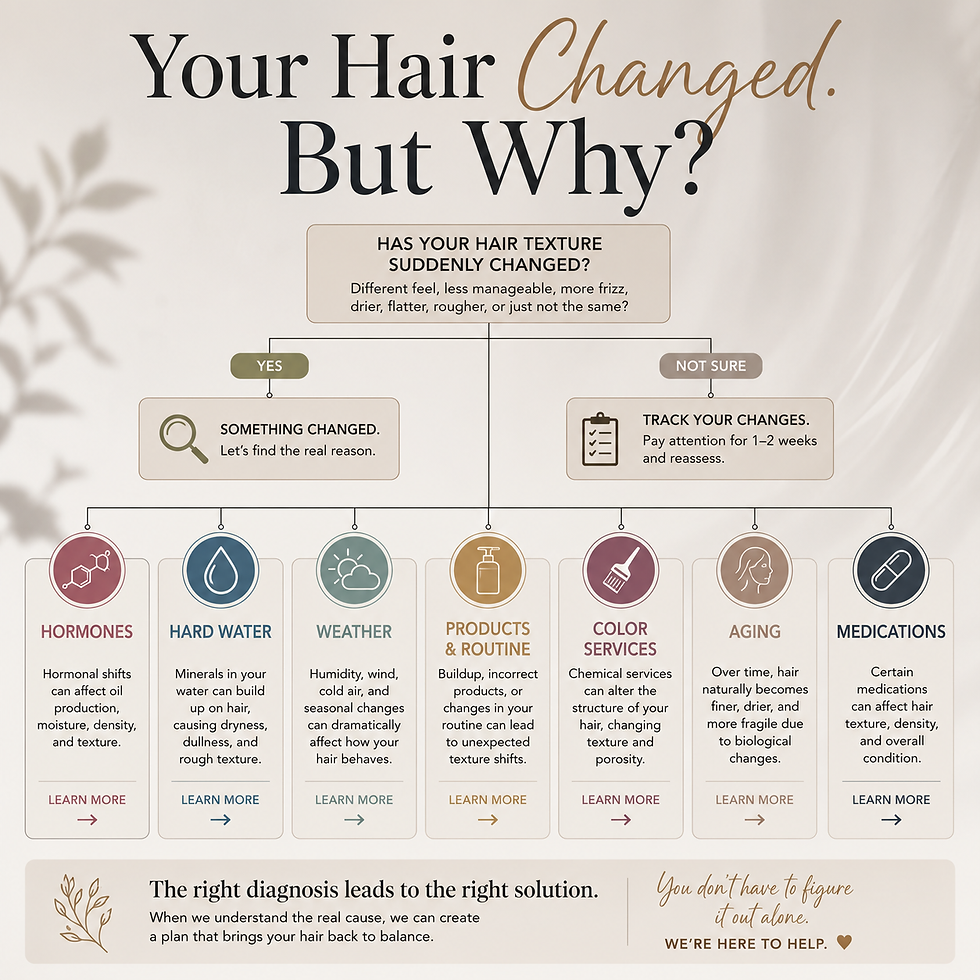
If your hair has changed significantly and you're unsure whether the problem is shedding, breakage, or a change in texture, our guide to why your hair suddenly changed texture explains how different changes in hair behavior can point toward different underlying causes.
2. Your Hair Is Breaking Instead of Shedding
Hair can feel thinner even when the number of hairs growing from your scalp hasn't changed much.
How?
Because the strands are breaking before they reach their usual length.
Think about someone whose hair used to feel thick from the roots to the ends.
Over time, repeated heat styling, bleaching, friction, or aggressive brushing may weaken portions of those strands.
The hair continues growing, but more pieces break off.
Eventually, the ponytail feels smaller, particularly toward the bottom.
This is especially common when the ends have accumulated years of styling and chemical exposure.
If your hair feels full near the scalp but noticeably thinner toward the bottom, our guide to why hair looks thinner toward the ends explains how breakage, density, and length retention are connected.
🌿 Free Hair Reset Guide
Stop Guessing. Start Understanding Your Hair.
Does Your Hair Feel Thinner, or Is Something Else Changing?
Hair that feels thinner can also feel flatter, more fragile, oilier, or harder to style. Those changes may look similar even when the causes are completely different.
Our free Hair Reset Guide walks you through the five biggest factors affecting your hair, helping you understand what may have changed before you start replacing products or adding unnecessary treatments.
3. Hormonal Changes May Be Affecting Your Hair
Hormones influence the hair growth cycle.
Changes associated with pregnancy, postpartum recovery, perimenopause, menopause, and thyroid conditions can sometimes affect shedding, density, or the texture of individual strands.
These changes don't always happen overnight.
You may notice that your ponytail gradually feels smaller or that your hair no longer has the same body it did a few years ago.
Sometimes the change is temporary. Other times it may reflect an ongoing shift that needs medical evaluation.
A stylist can help assess how your hair looks and behaves, but hormonal causes cannot be diagnosed by looking at the hair alone.
4. Your Hair Strands May Be Becoming Finer
Hair density and strand thickness are different things.
Density refers to how many hairs are growing in an area of your scalp.
Strand thickness refers to the diameter of each individual hair.
You can have plenty of hairs but still have naturally fine strands.
And over time, some people experience changes in strand diameter.
This may make hair feel softer, flatter, or less substantial when gathered into a ponytail.
In some forms of pattern hair loss, follicles gradually produce finer hairs, a process known as miniaturization.
If you notice a widening part, reduced coverage, or progressive thinning, a dermatologist can help determine whether that process is occurring.
5. Product Buildup Is Making Your Hair Look Flatter
Sometimes the hair isn't actually thinner.
It's simply behaving differently.
Heavy conditioners, styling creams, oils, dry shampoo, and other products can accumulate on the hair.
When fine or low-volume hair becomes weighed down, the strands may sit closer together.
Instead of looking full and separated, the hair appears flat.
You might notice:
Less volume at the roots
Hair that feels coated or unusually soft
A style that collapses quickly
Hair that looks oily sooner than expected
The key distinction?
Product buildup doesn't reduce the number of follicles producing hair.
It can, however, change how much volume those hairs create.
6. Your Hair's Natural Oil Production Has Changed
Your scalp produces sebum, a natural oil that helps lubricate the hair and scalp.
When oil production or washing habits change, your hair may start behaving differently.
Hair that previously had plenty of volume may begin looking flatter near the roots.
This can make the scalp more visible, particularly around the part.
But oily, flat hair is not automatically thinning hair.
If your hair feels fuller immediately after washing but loses volume quickly, oil distribution and product weight are worth considering.
7. You're Seeing the Effects of Several Small Changes
Sometimes there isn't one obvious cause.
You may be experiencing a little more shedding than usual.
Your hair may have accumulated some breakage.
Your styling products may also be weighing down the remaining length.
Individually, none of those changes seems dramatic.
Together, they can make your hair feel noticeably thinner.
This is one reason we encourage people to look at their entire hair history rather than focusing on a single symptom.
How Can You Tell Whether It's Shedding, Breakage, or Lost Volume?
The easiest place to begin is with what you're actually seeing.
Check | What to look for | What it may mean |
Your hairbrush | More long, full-length hairs than usual | Increased shedding |
Your ends | Uneven, frayed, or shorter pieces | Breakage |
Your part | More scalp visible over time | Reduced density |
Your ponytail | Smaller throughout, or mainly near the ends | Shedding or breakage |
After washing | Hair feels fuller, then quickly becomes flat | Oil, buildup, or styling weight |
Individual strands | Hair seems progressively finer | Possible changes in strand diameter |
A small pale bulb at one end of a shed hair can be normal. Its presence doesn't mean the entire follicle has fallen out.
And not every short hair is breakage. New growth can also create shorter pieces, particularly near the hairline.
The overall pattern matters more than any single strand.
Sometimes the difference appears only after shampooing. Understanding why hair can feel thinner after washing can help you distinguish temporary flatness from a lasting change in fullness.
If you're finding more hair in your brush or noticing shorter pieces, our guide to hair shedding vs. hair loss vs. breakage explains how to recognize the differences.
When Should You Be Concerned About Sudden Hair Thinning?
A change in hair volume doesn't always require medical treatment.
But some patterns deserve professional evaluation rather than another shampoo experiment.
Consider seeing a dermatologist or healthcare professional if you notice:
A widening part or progressively visible scalp
Distinct bald patches
Sudden, unusually heavy shedding
Scalp redness, pain, significant itching, or scaling
Thinning that continues or becomes more noticeable
Hair changes accompanied by other unexplained symptoms
The American Academy of Dermatology explains that hair shedding and hair loss are different processes, and that identifying the cause is important when determining whether treatment is needed.
One important distinction: if you have actual hair loss, a cosmetic product may improve how your hair looks or feels, but it cannot be assumed to address the underlying cause.
What Can You Do If Your Hair Suddenly Feels Thinner?
At-Home Support
Start by observing the pattern rather than changing your entire routine.
Look at where the difference is happening.
Does your hair feel thinner near the scalp, through the middle, or only at the ends?
Review recent changes.
Think about illness, stress, medications, nutrition, chemical services, and styling habits over the previous several months.
Reduce unnecessary breakage.
Be gentle when detangling, avoid excessive tension, and reduce repeated high-temperature styling on fragile areas.
Reconsider heavy products.
If your hair feels flat or coated rather than genuinely sparse, review how much conditioner, oil, or styling cream you're applying near the roots.
Track changes consistently.
A few photographs of your part and hairline taken in similar lighting can help you see whether the change is progressing.
Avoid judging your hair by one shower or one day of styling.
For more guidance on adjusting products when your hair starts behaving differently, see why your hair routine stopped working.
Professional Guidance
A hairstylist can evaluate whether your hair has:
Visible breakage
Uneven density through the lengths
Excessive product weight
Chemical or heat-related damage
Changes in texture and manageability
A dermatologist can assess possible medical causes of hair loss, including scalp conditions and changes in the hair growth cycle.
These roles complement each other.
The goal is to identify whether the concern is cosmetic, structural, or related to hair growth before choosing a solution.
What We'd Recommend in the Salon
At Cache' Salon, we wouldn't automatically recommend a thickening product to everyone who says their hair feels thinner.
We'd first want to understand whether the concern is actual shedding, fragile lengths, or a loss of styling volume.
If Your Hair Is Fine, Flat, and Lacking Body
Keune Absolute Volume
For hair that feels less full because the strands are fine or the style lacks lift, Keune Absolute Volume is a reasonable cosmetic option.
The updated Care range is designed to help fine hair feel fuller and more voluminous without a heavy finish.
It won't increase your number of hair follicles or treat medical hair loss, but it may help hair look and feel more substantial.
Learn More & Shop Keune Absolute Volume
If Your Hair Feels Thinner Because the Lengths Are Breaking
Keune Vital Nutrition
If the hair is dry, fragile, and breaking through the lengths, we'd focus on improving its condition rather than simply adding volume.
Keune Vital Nutrition is formulated for dry hair, with biomimetic ceramides and conditioning ingredients designed to nourish and strengthen damaged strands.
It can support the condition of existing hair, but it doesn't replace hair that has already shed or repair every form of structural damage.
Learn More & Shop Keune Vital Nutrition
If you're experiencing unexplained shedding, a widening part, or scalp symptoms, we'd recommend identifying the cause before investing in a new product routine.
🌿 Free Hair Reset Guide
Stop Guessing. Start Understanding Your Hair.
Your Hair Feels Different. Your Routine Should Start With Understanding Why.
Hair that feels thinner may also be drier, flatter, more fragile, or harder to manage. Those symptoms often overlap, making it easy to treat the wrong problem or purchase products that don't address what has changed.
Our free Hair Reset Guide helps you understand the five biggest factors affecting your hair, so you can recognize changes in your routine, environment, and hair condition and make more informed decisions about what to try next.
Professional Insight: We Look at Where the Fullness Has Changed
When someone tells us their hair suddenly feels thinner, one of the first things we'd want to know is where they're noticing the difference.
Is their ponytail smaller from the moment they gather it?
Do the ends look thinner while the roots still feel full?
Does the hair look flat only after styling?
Or are they noticing more scalp than they used to?
Those details change the conversation.
Hair that is breaking through the ends needs a different approach from hair that is shedding from the scalp.
And hair that's simply weighed down may not need a repair treatment at all.
The best consultations begin with understanding what's changed, not immediately deciding which product to use.
When Does a Salon Appointment Make Sense?
If your hair feels thinner because of breakage, dryness, or styling changes, a professional consultation can help you understand which parts of your routine may be contributing.
A stylist may recommend a gentler approach to chemical services, changes in heat styling, conditioning support, or a haircut to improve the appearance of thin, damaged ends.
For broader guidance on breakage and damaged lengths, explore our Hair Health & Repair Guide.
If you're experiencing significant shedding, a widening part, or suspected hair loss, a medical evaluation is the more appropriate first step.
The Bottom Line: Find Out What's Actually Getting Thinner
A smaller ponytail doesn't automatically mean you're losing your hair.
And hair that looks flat doesn't necessarily have less density.
The more useful question is:
Are you losing strands, breaking strands, or losing the volume your existing strands used to create?
Once you understand that distinction, it becomes much easier to decide whether your next step is a routine adjustment, professional haircare, or a medical evaluation.
Frequently Asked Questions
Can hair suddenly feel thinner without actually losing hair?
Yes. Oil, product buildup, changes in styling, and fine hair texture can make hair feel flatter and less substantial without reducing the number of hairs growing from your scalp.
Why does my ponytail suddenly feel smaller?
A smaller ponytail can result from increased shedding, breakage, changes in strand thickness, or a combination of factors. Look at whether the change is happening throughout the ponytail or mainly near the ends.
Can stress make your hair feel thinner?
Yes. Significant physical or emotional stress can sometimes trigger increased shedding, often after a delay of several months. Not all stress-related hair changes are the same, so persistent or significant shedding deserves evaluation.
Why does my hair feel thinner after washing?
Wet hair tends to clump together and lie flatter. Heavy conditioning products may also reduce volume. If your hair feels thinner only when wet, that doesn't necessarily indicate hair loss.
Can menopause make hair feel thinner?
Hormonal changes during perimenopause and menopause can affect hair growth, density, and strand thickness. A dermatologist can help evaluate progressive thinning and possible treatment options.
How can I tell if my hair is breaking or shedding?
Shedding often involves full-length hairs, sometimes with a small bulb at one end. Breakage produces shorter fragments of varying lengths, often with rough or damaged ends. The distinction isn't always obvious from individual strands.
Will volumizing shampoo help thinning hair?
Volumizing shampoo may make fine or flat hair appear fuller, but it doesn't necessarily address the cause of actual hair loss. Its usefulness depends on whether the concern is cosmetic volume or reduced density.
Can hair grow back after sudden thinning?
Sometimes. Certain forms of temporary shedding can improve once the triggering factor resolves. Other types of hair loss require medical evaluation and may benefit from early treatment.
Should I see a hairstylist or dermatologist for thinning hair?
A hairstylist can help evaluate breakage, damage, and styling-related volume concerns. A dermatologist is the appropriate professional for unexplained shedding, widening parts, bald patches, or suspected medical hair loss.
Want help choosing the right pro products for your hair? Explore our Keune Experience.
Written by Tammy Brown
Owner of Cache' Salon in Hanford, CA
18-year cosmetologist specializing in color, transformations, and education.


Comments