

What Temperature Should You Use on Your Flat Iron? A Guide by Hair Type | Cache' Salon Hanford

What Temperature Should You Use on Your Flat Iron? A Guide by Hair Type
Your flat iron goes to 450°F.
So...
are you supposed to use 450°F?
Probably not.
One of the most common mistakes with flat ironing is assuming hotter means:
straighter
smoother
or
longer-lasting.
Sometimes more heat does make resistant hair straighten faster.
But there is a point where you're adding thermal stress without getting a meaningful styling benefit.
And that point is different depending on whether your hair is:
fine
thick
coarse
lightened
color-treated
already damaged
The goal isn't to find the hottest temperature your hair can survive.
It's to find the lowest temperature that gives you the result you want efficiently.
Quick Answer: What Temperature Should You Use on Your Flat Iron?
For many people, a useful starting range is around 300°F to 350°F, then adjusting based on the condition and thickness of the hair.
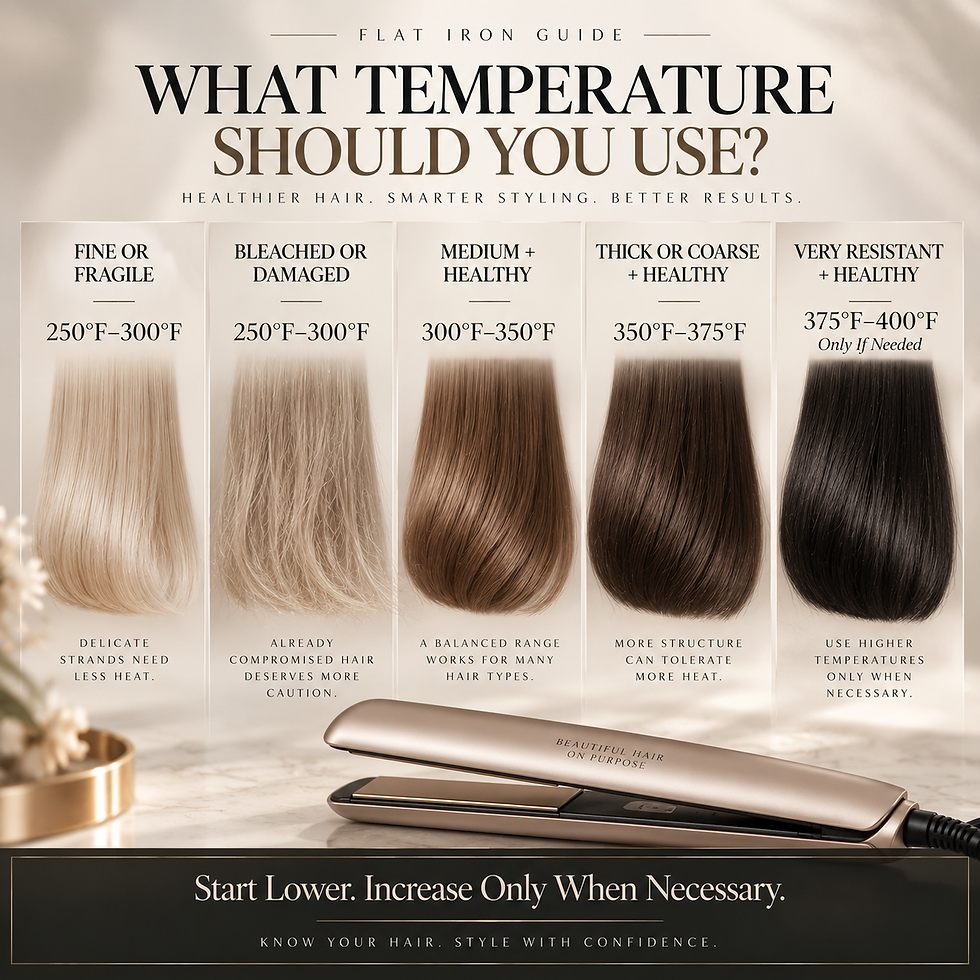
Fine, fragile, heavily lightened, or damaged hair often needs a more conservative range, sometimes around 250°F to 300°F. Medium or relatively healthy hair may respond well around 300°F to 350°F. Thick, coarse, or resistant healthy hair may need 350°F to 375°F, and occasionally more.
Those are practical starting ranges, not universal safety limits.
The American Academy of Dermatology recommends using flat irons only on dry hair, choosing a low or medium heat setting, and using the lowest effective temperature for your hair.
A Practical Flat Iron Temperature Guide
Hair Condition | Starting Range |
Fine or fragile | 250°F–300°F |
Bleached or significantly damaged | 250°F–300°F |
Medium / relatively healthy | 300°F–350°F |
Thick or coarse / healthy | 350°F–375°F |
Very resistant, coarse healthy hair | 375°F–400°F only if needed |
400°F+ | Usually not where we'd start at home |
The important word is:
starting.
You may discover that your hair straightens beautifully at 315°F.
If so...
there is no prize for turning it to 390°F.
Your Flat Iron's Maximum Temperature Is Not a Recommendation
This is worth clearing up immediately.
A flat iron that reaches:
400°F
430°F
or
450°F
doesn't mean your hair needs that temperature.
The maximum exists because different hair types and professional applications require different capabilities.
Think about your oven.
Just because it reaches 500°F doesn't mean every meal belongs at 500°F.
Hair works the same way.
The tool's capability and your hair's requirement are two completely different things.
If you heat-style regularly, Heat Styling Every Day: How to Minimize Hair Damage Without Giving Up Your Style explains how temperature, frequency, technique, and heat protection work together.
Why Higher Heat Can Straighten Faster
Heat temporarily changes some of the bonds that influence the shape of your hair.
As the temperature increases, reshaping can become faster.
That's why resistant hair may look smoother after:
one controlled pass at an appropriate temperature
than after:
five weak passes at a temperature too low to do the job.
So the answer is not always:
“Turn the temperature as low as possible.”
The better rule is:
Use the lowest effective temperature that allows you to style efficiently with minimal passes.
That's a very different idea.
1. Fine Hair Usually Needs Less Heat
Fine hair has a smaller strand diameter.
That means you generally don't need extreme temperatures to reshape it.
If your hair is:
fine
naturally straight or lightly wavy
easily flattened
quick to style
start conservatively.
Something around:
250°F–300°F
may be enough.
Then move up slightly only if needed.
If your hair looks straight after one smooth pass at 285°F, turning the iron to 375°F isn't making the style “better.”
It's simply exposing the strand to more heat.
2. Bleached or Highlighted Hair Deserves More Caution
This is one of the biggest exceptions to styling by texture alone.
You may have:
thick hair
but also:
heavily highlighted hair.
Thickness might suggest you can tolerate more heat.
The chemical history says:
be careful.
Lightened hair may already have more:
porosity
structural wear
dryness
weakness
breakage risk
So I would prioritize condition over thickness.
A thick blonde that has been heavily lightened may need a lower flat-iron temperature than healthy, untreated hair of the same thickness.
This is also why the same temperature may work beautifully on your roots...
and be too aggressive for your ends.
3. Medium Hair Often Doesn't Need Extreme Heat Either
For medium-density strands that are relatively healthy, a practical starting point is often:
300°F–350°F
Then assess.
Did one controlled pass smooth the section?
Good.
Stop there.
If you're repeatedly going over the exact same section because it didn't straighten, you may need:
slightly more heat
smaller sections
better tension
a better tool
better preparation
Notice that temperature is only one variable.
4. Thick or Coarse Hair May Need More Heat
This is where overly simplistic advice like:
“Never use more than 300°F”
falls apart.
Some thick, coarse, resistant hair genuinely needs more thermal energy to reshape efficiently.
The American Academy of Dermatology specifically notes that thicker, coarser hair may require a higher setting while still recommending the lowest possible temperature that produces the desired result.
For healthy coarse hair, you might start around:
350°F
and adjust upward if necessary.
For some resistant hair:
375°F–400°F
may produce a cleaner result with fewer passes.
But hair condition still wins.
Coarse does not automatically mean indestructible.
What Matters More: Temperature or Number of Passes?
Both matter.
This is where flat-ironing advice gets complicated.
Imagine two routines:
Routine A
300°F
Five passes over every section.
Routine B
340°F
One controlled pass.
You can't look at temperature alone and automatically say Routine A is gentler.
The hair is also exposed to:
contact time
pressure
number of passes
frequency
section size
That is why we care about effective temperature, not just the lowest number on the dial.
The goal is:
enough heat to style efficiently
without:
repeatedly cooking the same section.
5. Damaged Hair Should Not Be Treated Like Healthy Hair
If your hair already feels:
brittle
rough
crispy
weak
unusually frizzy
prone to breaking
thin through the ends
the question changes.
Instead of:
“How hot should I make my flat iron?”
ask:
“Should I be flat ironing this hair right now?”
Lower temperature can reduce additional stress.
But lower temperature does not magically make compromised hair healthy enough for unlimited heat.
If you're already seeing signs of thermal damage, Is Heat Damage Reversible? What Can Actually Be Fixed explains what can improve and what may eventually need to grow out or be trimmed.
Is 450°F Too Hot for Hair?
For routine home styling, I would not treat 450°F as a normal target.
There may be professional situations where very high temperatures are used intentionally on appropriate hair.
But that does not make 450°F the default.
Laboratory research on hot flat ironing has documented changes to hair keratin, reduced moisture retention, surface damage, and increased breakage under repeated high-temperature thermal stress. One published study specifically notes that flat irons operating above 200°C, about 392°F, can produce significant hair keratin damage.
That does not mean 391°F is universally safe and 392°F suddenly destroys hair.
Hair damage is not an on/off switch.
It is cumulative.
Temperature is one part of the total exposure.
6. Your Ends May Need a Lower Temperature Than Your Roots
This is one of the smartest adjustments you can make.
Your roots are newer.
Your ends may have already experienced:
years of washing
brushing
coloring
bleaching
blow drying
flat ironing
sunlight
friction
So why would you automatically give both areas identical heat?
You don't have to.
You might use:
a slightly higher effective setting through resistant newer growth
and:
less heat through fragile ends.
Or you may not need to clamp the ends again at all.
If the bottom of your hair already feels significantly drier than the top, why your ends are dry but your roots are healthy explains why the oldest hair often behaves differently.
Never Flat Iron Hair That Is Still Damp
This one is not negotiable with a conventional flat iron.
Your hair should be fully dry before the plates touch it unless you are using a tool specifically designed and instructed for wet-to-dry styling.
If you hear:
sizzling
or see unusual:
steam
stop.
You do not want water inside the strand rapidly heating while the hair is compressed between hot plates.
The American Academy of Dermatology also specifically recommends using flat irons on dry hair.
🌿 Free Hair Reset Guide
Stop Guessing. Start Understanding Your Hair.
The “Right” Temperature Depends on the Hair You're Starting With
Fine hair, bleached hair, coarse hair, dry hair, and damaged hair should not automatically be treated the same way.
And if you're constantly increasing the heat because your hair has become harder to style, the temperature may not be the real problem.
The Free Hair Reset Guide walks you through the five biggest factors affecting your hair so you can understand its condition before deciding how much heat, moisture, repair, or routine adjustment it actually needs.
7. Heat Protectant Helps, but It Doesn't Make 450°F Harmless
This is another important misconception.
Heat protectant is valuable.
It can reduce thermal stress.
But it does not create an invisible force field around the strand.
You can still overwhelm protected hair with:
excessive temperature
repeated passes
daily flat ironing
prolonged contact
existing chemical damage
Think of heat protection as:
risk reduction
not:
permission to use unlimited heat.
The American Academy of Dermatology recommends using heat-protecting products while also limiting flat-iron heat rather than treating those as interchangeable choices.
The Tool Matters Too
Temperature control is much harder if your iron only has:
Low / Medium / High
or jumps unpredictably between settings.
An adjustable digital or clearly marked temperature control gives you a much better chance of finding your actual effective range.
Plate condition matters too.
If the plates:
snag
pull
have damaged edges
heat unevenly
you may compensate by making more passes.
That defeats the point.
Affiliate Disclosure: Some links on this page are affiliate links. If you make a purchase through one of these links, Cache' Salon may earn a commission at no additional cost to you.
If You're Replacing Your Flat Iron
For someone who regularly straightens or smooths their hair at home, we recommend the BaBylissPRO Nano Titanium Ultra-Sleek Hair Straightener.
This isn't being recommended because a more expensive iron makes heat harmless.
It doesn't.
What we like here is the ability to use a professional-style tool with controllable heat rather than treating maximum temperature as the goal.
It's also the exact flat iron Vivian uses professionally at Cache' Salon.
Check the BaBylissPRO Nano Titanium Ultra-Sleek Hair Straightener on Amazon
What We'd Recommend in the Salon
If someone asked us:
"What temperature should I use on my flat iron?"
we would not answer from hair type alone.
We'd also look at:
color history
lightener history
strand thickness
porosity
existing damage
how many passes are needed
how frequently the hair is straightened
whether the ends are weaker than the roots
Then we'd choose the lowest effective setting.
If You Flat Iron Regularly
For direct hot-tool styling, Keune Style Tame Game is a more natural fit here than forcing one of the Care products.
Keune describes Tame Game as a smoothing styling cream with Panthenol, Vitamin E, and Castor Oil, and it provides heat protection up to 230°C / 446°F. Keune's current heat-protection guidance specifically identifies Tame Game as an option for flat-iron or curling-iron styling.
Apply it according to the product directions before styling.
And remember:
A product rated for high-temperature protection does not mean your hair should be styled at that maximum temperature.
Protection rating and ideal styling temperature are two different things.
If Your Hair Already Feels Damaged
Then I would not solve that by simply layering more styling product over it.
Your priority shifts toward understanding the condition of the strand.
If you're seeing:
roughness
breakage
thin ends
persistent dryness
loss of elasticity
Our Hair Problems Resource Center can help you compare heat damage with other problems that can make hair feel difficult to style.
How to Find Your Lowest Effective Temperature
The best flat-iron temperature is not the lowest number your tool offers.
And it is not the highest number your hair can tolerate.
It is the lowest temperature that gives you the result you want with good technique and minimal passes.
That may take a little testing.
But once you find it, styling gets much easier.
At-Home Support
1. Start Lower Than You Think You Need
If you're unsure where to begin, start conservatively.
For many people, somewhere around:
275°F–300°F
is a reasonable testing point.
Then ask:
Did one controlled pass smooth the section?
If yes, stay there.
If not, increase gradually.
Think:
10°F–15°F at a time
rather than jumping straight from 300°F to 400°F.
The goal is to find the point where the iron becomes effective without using unnecessary heat.
2. Use Small Enough Sections
If your section is too thick, the iron may only fully heat the outer layers.
Then you go over it again.
And again.
And again.
That can make it look like the temperature is too low when the real problem is section size.
A better section should allow the plates to make even contact with the hair.
You should not have to squeeze the iron excessively or make repeated passes just to reach the interior strands.
3. Comb the Section Before You Flat Iron It
Smooth sections style more efficiently.
Before the iron touches the hair:
detangle the section
make sure the strands are aligned
remove obvious knots
keep the section controlled
Some stylists use a comb-chase technique, where a comb helps align the hair immediately before the iron passes over it.
The idea is simple:
better alignment can mean fewer passes.
4. Keep the Iron Moving
Do not clamp the iron in one spot and hold it there.
Move smoothly through the section.
You want enough contact time to reshape the hair...
without cooking one area.
If you need to slow down dramatically to make the section straight, consider whether:
the section is too large
your temperature is too low
the tool isn't heating evenly
the hair isn't prepared properly
5. Aim for One Controlled Pass
One good pass is the goal.
That does not mean you will never need a second pass.
But if you routinely need:
four, five, or six passes
something should change.
Maybe:
the section needs to be smaller
the hair needs better tension
the temperature needs a slight adjustment
the iron needs replacing
the hair is too coated or resistant
Repeated passes are not automatically safer just because the temperature is lower.
6. Lower the Temperature on Fragile Ends
Your ends do not always need the same setting as your roots.
If the ends are:
lightened
dry
split
thinner
porous
fragile
you can reduce the heat there.
You may even find that you only need to smooth the upper section and lightly glide through the ends once.
This is especially useful for long hair that has accumulated years of wear.
7. Do Not Flat Iron the Same Hair Every Day if You Can Avoid It
Temperature matters.
Frequency matters too.
Even an appropriate temperature can become too much when the same sections are heated over and over.
If your style holds for:
two days
three days
or longer
you may be better off touching up only the areas that actually need it.
If you heat-style frequently, how often is too often to use heat on your hair is the next question to think about.
Signs Your Flat Iron Is Too Hot
Sometimes your hair tells you immediately.
Other times the warning signs build gradually.
Watch for:
a burnt smell
visible smoke
sizzling
steam from hair that should already be dry
hair feeling crispy afterward
ends becoming increasingly brittle
color fading faster
blonde becoming warmer
hair losing shine
more breakage
natural curl pattern weakening
One sign does not prove the temperature is the only cause.
But if those changes appear after increasing your heat, pay attention.
If You Smell Burning, Stop
A slight “hot tool” smell and a true burnt-hair smell are not the same thing.
If your hair smells scorched after flat ironing, do not just cover it with fragrance or oil.
Ask:
Was the hair fully dry?
Was there product buildup?
Was the temperature too high?
Did you hold the iron too long?
Did you make repeated passes?
That smell is useful information.
What About Color-Treated Hair?
Color-treated hair deserves more caution.
Especially if the hair is:
highlighted
bleached
balayaged
repeatedly lightened
already dry or porous
Heat can affect both:
hair condition
and
color longevity.
So if you have color-treated hair, I would not choose a temperature based only on strand thickness.
Condition matters more.
A thick strand with significant bleaching may still need a conservative setting.
What About Curly or Coily Hair?
Curly and coily hair can often require more work to straighten because the natural shape is stronger.
But that does not automatically mean:
turn the iron to maximum.
The goal is still:
proper preparation
small sections
controlled tension
efficient passes
the lowest effective heat
Healthy, coarse curls may tolerate more heat than fragile, lightened curls.
Again, condition comes first.
What About Fine Blonde Hair?
This is one of the easiest combinations to overheat.
Fine strands already need less heat.
Bleaching adds another reason for caution.
So fine highlighted or blonde hair should generally be treated more conservatively than untreated medium or coarse hair.
This is also where one-pass technique becomes important.
Repeated lower-temperature passes can still create cumulative stress.
What About Thick, Resistant Hair?
Thick, coarse, resistant hair may genuinely need more heat.
That is where moving into the:
350°F–375°F range
may make sense.
Some hair may need more.
But the decision should be based on what the hair is actually doing.
If 360°F gives you a smooth result in one pass, you do not automatically need 400°F.
Temperature Is Only One Part of the Equation
This is probably the biggest takeaway in the whole article.
Flat-iron damage depends on more than the number on the screen.
It also depends on:
frequency
contact time
number of passes
section size
hair condition
chemical history
moisture level
heat protection
tool quality
That is why two people can both use 350°F and get completely different outcomes.
If heat styling has already left your hair dry, weak, rough, or prone to breakage, our Hair Health & Repair Guide explains how heat damage, moisture loss, breakage, porosity, and repair needs can overlap.
Professional Guidance
A professional consultation may make sense if:
you need extremely high heat to get any result
your ends keep breaking
blonde or highlighted sections feel fragile
your hair smells burnt after styling
your natural curl pattern has changed
your hair feels crispy or rough after flat ironing
you are unsure whether the issue is technique or damage
At Cache', we would look at:
strand thickness
porosity
elasticity
color history
lightener history
heat frequency
breakage
condition of the ends
product buildup
tool temperature
styling technique
The goal is not to give everyone the same number.
It is to match the temperature to the hair in front of us.
🌿 Free Hair Reset Guide
Stop Guessing. Start Understanding Your Hair.
The Right Heat Setting Depends on More Than Hair Type
Two people can both have thick hair and need completely different flat-iron temperatures.
One may have healthy, untreated hair.
The other may have years of highlights, dryness, and breakage.
The Free Hair Reset Guide walks you through the five biggest factors affecting your hair so you can understand its condition before deciding how much heat, repair, moisture, or protection it actually needs.
Professional Insight
When someone asks us:
"What temperature should I use?"
we usually do not start with the number.
We start with the hair.
We look at:
how easily it smooths
how many passes it needs
where the weakest areas are
whether the ends are lightened
whether the hair is already damaged
how frequently the client uses heat
Then the number becomes much easier to choose.
That is why “350°F is safe” or “450°F is too hot” are both overly simple statements.
The right answer is contextual.
Professional Service Options
Depending on what the hair is showing, useful options may include:
Hair Health Consultation
Heat-Damage Evaluation
Moisture Balance Review
Conditioning Treatment
Bond-Support Treatment
Trim or Dusting
Styling Technique Review
Customized Home Care Recommendations
Not every flat-iron issue needs a salon service.
Sometimes a lower temperature and better technique are enough.
Stop Asking, “What Is the Safest Temperature?”
A better question is:
“What is the lowest temperature that gives me the result I need without repeated passes?”
That gets you closer to a useful answer.
For one person, that may be:
285°F
For another:
330°F
For another:
370°F
The number matters.
But the hair matters more.
Frequently Asked Questions
What temperature should I use on a flat iron for fine hair?
A lower range, often around 250°F–300°F, is a reasonable starting point for fine or fragile hair.
What temperature should I use for thick hair?
Healthy, thick, coarse hair may need around 350°F–375°F, sometimes more if it is very resistant.
Is 400°F too hot for a flat iron?
Not always, but it is higher than many people need. If your hair styles effectively at a lower temperature, there is no benefit to increasing it.
Is 450°F too hot for everyday use?
For routine home styling, I would not treat 450°F as a normal default. Very high heat should be approached cautiously and is unnecessary for many hair types.
What temperature should I use on bleached hair?
Bleached or heavily highlighted hair usually deserves a more conservative setting, often around 250°F–300°F depending on its condition.
Can low heat still damage hair?
Yes. Repeated passes, long contact time, frequent styling, and existing damage can still create stress even at lower temperatures.
Should I flat iron wet hair?
Not with a conventional flat iron. Hair should be fully dry unless the tool is specifically designed for wet-to-dry use.
Does heat protectant let me use a higher temperature?
No. Heat protectant can reduce thermal stress, but it does not make excessive heat harmless.
Why do I need several passes even at high heat?
The section may be too large, the tool may not be heating evenly, or the hair may need better preparation or tension.
How do I know if my flat iron is damaging my hair?
Watch for increasing dryness, brittleness, breakage, dullness, burnt smell, color fading, or changes in your natural texture.
Want help choosing the right pro products for your hair? Explore our Keune Experience.
Written by Tammy Brown
Owner of Cache' Salon in Hanford, CA
18-year cosmetologist specializing in color, transformations, and education.


Comments